

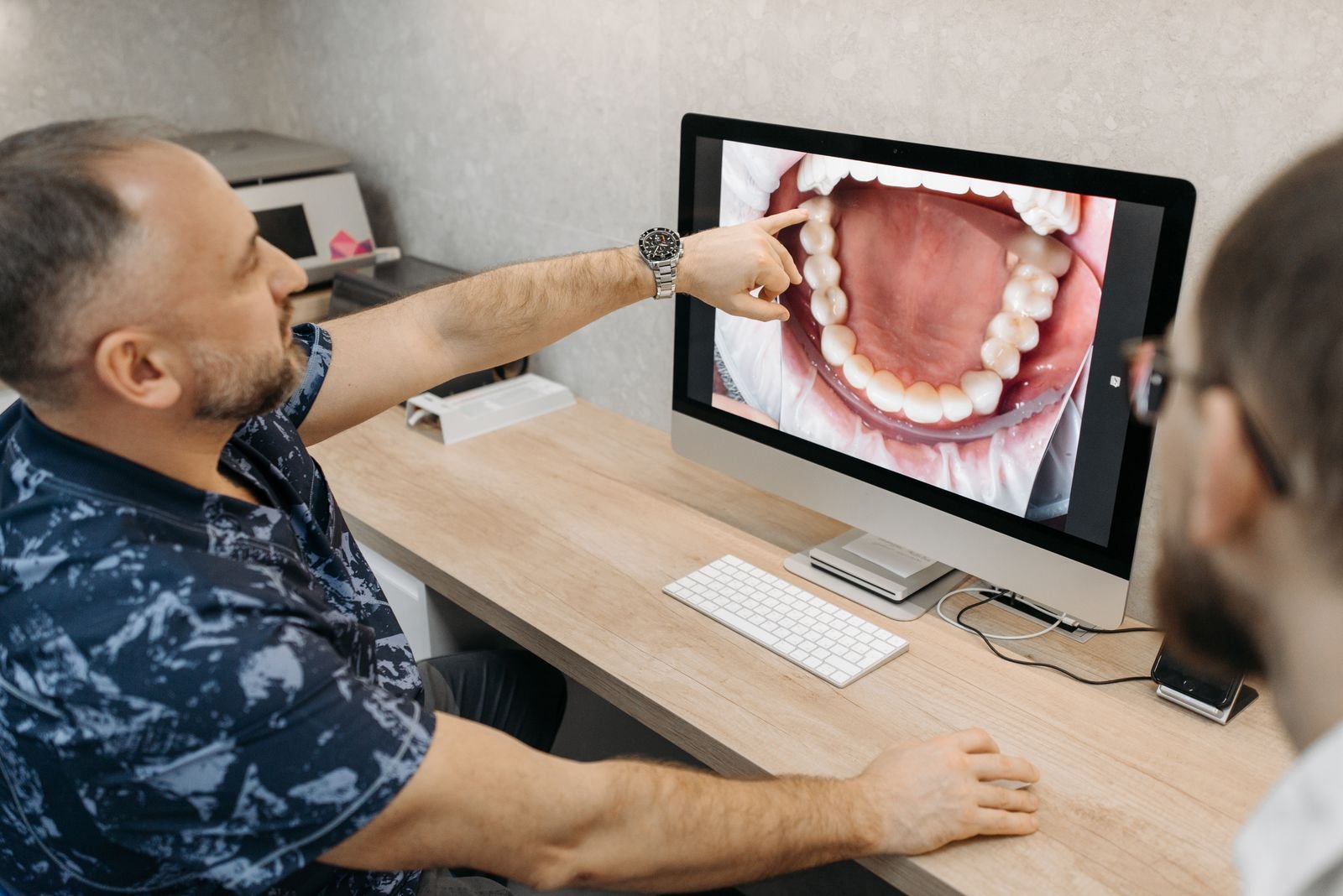
Your dentist finishes a root canal, seals the tooth, and sends you off with the sentence millions of patients hear every year: “We’ll know in about a year whether it healed.” That wait — the slow radiographic verdict on whether the infection at the root tip quietly resolves or festers — is one of dentistry’s quiet blind spots. The whole pitch for AI root canal healing prediction is that a model could call the outcome the day the file comes out. A new study put three of them to the test, and the real story is hiding in the error bars.
The 30-Second Version
- A new Journal of Endodontics study trained three machine-learning models to predict whether a root canal will heal — favorably or not — from routine clinical and radiographic data.
- The headline looks great until the fine print: a model that scored 80.4% accuracy caught 0% of the actual treatment failures.
- Only after the researchers deliberately lowered the alert threshold did failure-detection reach 90.9% — but then just 30.3% of its warnings were real.
- The honest caveat: this is 276 cases from one center, with no external validation. It’s a lesson in reading AI metrics, not a tool you can use yet.
It sounds like a leap forward. But the details matter. In the Journal of Endodontics, Dufey-Portilla and colleagues trained three machine-learning models — logistic regression, a random forest, and a support-vector machine — on 276 single-tooth root canals performed by endodontists, each with its healing outcome judged clinically and radiographically 12 to 18 months later. Their question wasn’t “can AI read a scan?” It was harder: can a model predict, in advance, which teeth will fail to heal?
The study, in one glance
The design is refreshingly honest about its limits. This was a retrospective study: the researchers looked back at completed cases, labeled each as favorable or unfavorable healing, and asked the models to separate the two from baseline features. Crucially, unfavorable healing — the clinically important outcome, the one you’d actually want a warning about — occurred in just 18.8% of cases. That imbalance is the whole plot.
What an AI root canal healing model gets right
There is something genuinely useful buried here. The best-performing model, a random forest, reached a ROC-AUC of 0.724 — modest, but better than a coin flip at ranking risky teeth above safe ones. Tooth type and the size of the baseline lesion carried the most predictive weight, which squares with what endodontists already know: large periapical lesions on complex teeth are the ones to watch. A tool that nudges a clinician to book a tighter follow-up for exactly those cases is plausible — and, much like the AI pulpotomy models we examined earlier and the other work in our endodontics & restorative coverage, it reads as a decision aid, not a decision.
So why did the ‘accurate’ model catch nothing?
Here is the catch that should stop every AI headline in its tracks. A model can score 80.4% on accuracy by doing something useless: predicting “this will heal” for every single tooth. Because failures are rare — only 18.8% of cases — blind optimism is right 81.2% of the time. Accuracy: 80.4%. Failures detected: zero. The authors flag this explicitly, and it may be the single most important sentence in the paper.
⚠ The accuracy trap
In an imbalanced dataset, “accuracy” rewards a model for ignoring the rare event you care about most. A 90%-accurate failure predictor that never actually flags a failure isn’t just unhelpful — it’s falsely reassuring.
It’s a smoke detector calibrated never to go off: technically right 99 nights out of 100, and catastrophically wrong on the night that matters.
Even the tuned models have a ceiling. With oversampling and SMOTE applied to the training data only, the support-vector machine pushed its precision-recall score for failures (PR-AUC) to 0.535 and sensitivity to 54.5% — better, but still missing nearly half of failures at default settings. And it all rests on 276 cases from a single setting, scored retrospectively, with no external validation — a model that looks sharp on its home data has told us little until it is tested elsewhere.
What happens when you force it to catch failures?
You can tune a model to stop missing failures — but statistics sends the bill elsewhere. When the researchers lowered the decision threshold to raise the alarm more readily, failure-detection (sensitivity) jumped to 90.9%. Impressive, until you see the cost: specificity fell to 48.9%, and the positive predictive value dropped to 30.3%. In plain terms, the aggressive model caught almost every failing tooth, but roughly two out of every three teeth it flagged as “at risk” were actually going to heal just fine. Who decides which error is worse — a missed failure, or a false alarm that triggers an unnecessary retreatment? That is not a question the algorithm can answer.
Does a single-center model work on your mouth?
A prediction model is only as representative as the patients it learned from. These 276 cases came from one group of endodontists, with their referral mix, their imaging equipment, and their definition of “healed.” A practice serving a different population might see the model’s already-modest accuracy slip further. Until these tools are validated across clinics and communities, the quiet risk is that AI prognosis works best for the patients who already receive the best care, and worst for everyone else.
What this means for you
If you’re a patient
If a dentist ever offers an “AI prediction” that your root canal will heal, treat it as a weather forecast, not a guarantee. The honest answer is still the old one: healing is confirmed on a follow-up radiograph months later. A good model might flag your tooth for closer monitoring — which is a reason to keep that review appointment, not skip it.
If you’re a clinician
Watch the metric, not the marketing. Ask any prognostic tool for its sensitivity and positive predictive value on the failure class, not its overall accuracy. On imbalanced outcomes like endodontic healing, accuracy is nearly meaningless, and a tool tuned for high sensitivity will bury you in false alarms unless you have decided in advance what false-positive rate your practice can live with.
The bottom line
Predicting whether a tooth will heal is exactly the kind of judgment we would love to outsource — and exactly the kind that resists easy automation. This study’s real contribution isn’t a deployable tool; it’s a discipline. It shows, with uncomfortable clarity, that the number which sells an AI product — accuracy — is often the number that hides its failures. Used well, a model like this is an assistant that whispers “watch this one,” never an oracle that declares a tooth saved. The year-long wait for a healing radiograph isn’t going away. But a model honest about its own blind spots might at least tell us where to look.
Frequently asked questions
Can AI predict whether my root canal will heal?
Not reliably yet. In this study, machine-learning models could rank teeth by risk a little better than chance (best ROC-AUC 0.724), but they were trained and tested on just 276 cases at one center, with no external validation. They may eventually help flag high-risk teeth for closer follow-up, but they can’t replace the radiographic check months later that actually confirms healing.
Why did a model with 80% accuracy “catch 0% of failures”?
Because failures were rare — only 18.8% of cases. A model can score 80.4% accuracy simply by predicting “will heal” for every tooth, which makes it right most of the time but useless for spotting the failures that matter. That is why experts judge these tools on sensitivity and positive predictive value, not accuracy alone.
What’s the downside of tuning AI to catch more failures?
False alarms. When the researchers lowered the threshold to catch 90.9% of failures, the positive predictive value fell to 30.3% — meaning roughly two-thirds of the teeth flagged as “at risk” would actually have healed. Over-flagging can drive unnecessary worry, imaging, or retreatment.
Should endodontists use this tool today?
Not as a standalone predictor. The authors themselves call the results preliminary and say external validation is needed before clinical use. At best it points to which cases — complex teeth with large lesions — deserve closer monitoring.
Source & author credit
This article interprets, and does not reproduce, the following peer-reviewed study. All figures are the authors’ original findings.
Dufey-Portilla N, Peña-Bengoa F, Abarca J, Macancela Bojorque CJ, Mercade M, Sanz-Serrano D, Abella Sans F, Garcia-Font M, Silva EJNL, De-Deus G, Versiani MA. Machine Learning Models for Predicting Periapical Healing after Primary Nonsurgical Endodontic Treatment. Journal of Endodontics. 2026; advance online publication. DOI: 10.1016/j.joen.2026.10.007
ORCID — Fernando Peña-Bengoa 0000-0001-9389-0468; Jaime Abarca 0000-0002-1068-6814; Carlos J. Macancela Bojorque 0000-0002-8265-3261; Montse Mercade 0000-0003-1303-3787; Marco A. Versiani 0000-0001-5277-9827.
The source article is subscription-access, © 2026 American Association of Endodontists, published by Elsevier (all rights reserved). Decadentry is an independent educational publication and is not affiliated with the study’s authors. Every article is checked against its primary source under our editorial standards.
Leave a Reply