

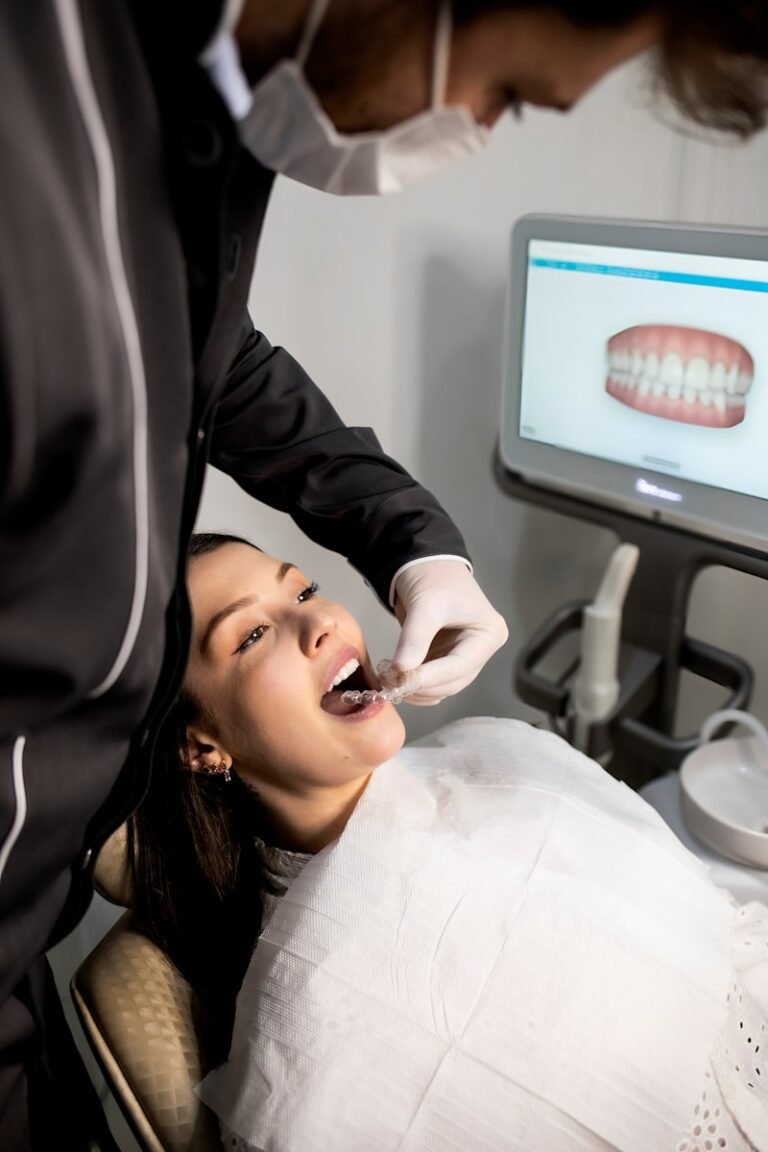
Before a single bracket goes on, your orthodontist swivels the monitor and shows you a photograph of your own face — after treatment. The jaw sits softer, the profile is balanced, the lips settle just so. It looks like a candid snapshot from next year. It isn’t. It’s an AI orthodontic simulation, generated in seconds by a diffusion model, and it may be the most persuasive image in the entire consultation.
The 30-Second Version
- A new system pairs Stable Diffusion with ControlNet to paint a photorealistic “after” profile that follows a target cephalometric (soft-tissue) outline.
- It was convincing: ordinary people told the AI faces from real photos only 51.3% of the time — a coin flip — and even orthodontists managed just 71.0%.
- Contour fidelity was tight: 95% of the synthesized landmarks fell within the 2 mm clinicians treat as accurate, and realism ratings showed no difference between fake and real (p = 0.579).
- The honest caveat: it was built and tested on just 10 patients, all adult Asian women — and it doesn’t predict your outcome, it renders the one it’s told to draw.
It sounds revolutionary. But the study behind these images — published by Fengcong Wang and colleagues in the Journal of Dentistry (2026) — was small, single-centred, and pointed at one narrow question: can a machine draw a face realistic enough to survive expert scrutiny? The answer is a striking yes. The harder question it can’t answer is the one that matters most in the chair: does a beautiful, believable picture help a patient understand their treatment, or just sell them a future nobody has actually promised?
The study, in one glance
The team took paired records from ten adult Asian female patients who had finished orthodontic treatment — each with a post-treatment cephalogram (the side X-ray orthodontists trace) and a matching profile photograph. They traced the soft-tissue outline, registered it to the photo, then erased and re-synthesized the lower third of the face using a Stable Diffusion inpainting model steered by ControlNet, so the generated skin, lips and chin were forced to follow that traced contour. They graded the results four ways: how far the synthesized landmarks drifted from the target, image-quality scores (LPIPS, SSIM, PSNR), a Visual Turing Test, and blinded realism ratings by orthodontists and laypeople.
What AI orthodontic simulation gets impressively right
On its own terms, the system is a genuine feat of engineering. The mean landmark error was just 1.38 ± 0.13 mm, with 95% of deviations inside the 2 mm most clinicians accept as good enough. The image-quality numbers were strong across the board (LPIPS 0.089, SSIM 0.951, PSNR 28.69 dB), and the realism held up under human eyes: laypeople hovered at chance, orthodontists caught the fakes only about seven times in ten, and formal realism ratings couldn’t separate generated faces from real ones at all. Synthesizing a photorealistic lower face that hits a precise contour and fools trained specialists is not a parlour trick — it is hard, and the model does it well.
But is a believable picture the same as a true prediction?
Here is the twist the glossy output hides. ControlNet wasn’t guessing your future — it was handed it. The contour that steered every image was traced from each patient’s real, already-completed post-treatment X-ray. The model was, in effect, shown the answer and asked to paint a convincing face onto it. So what the study actually measures is rendering fidelity — how faithfully the system draws a face from a known outline — not predictive accuracy. In a real consultation, nobody has next year’s cephalogram. You have a treatment plan and a predicted contour, and if that prediction is off, the diffusion model will render the wrong face with the same flawless, photographic confidence.
⚠ A rendering, not a forecast
This study validated how realistically the system draws a face from a contour it was given, not whether it can foresee your result. The very realism that makes the image persuasive is what makes a wrong input dangerous: a mistaken prediction still comes out looking like a photograph.
It’s an architect’s photorealistic render, not a weather forecast — stunning, precise to the blueprint you feed it, and only ever as right as that blueprint.
Then there is the sample. Ten patients — all adult Asian women, from a single retrospective set, with no external validation — is a proof of concept, not evidence of clinical readiness. Diffusion models are also prone to quietly “beautifying,” smoothing skin and idealizing features in ways that flatter rather than inform, and only the lower third of the face was synthesized, leaving the rest untouched. As with other camera-based orthodontic AI — like the tool that measures tooth crowding from a single photo — the demo dazzles, but the boundaries are set by how, and on whom, it was tested.
Who owns the face the patient remembers?
A photorealistic “after” image doesn’t read like an estimate; it reads like a promise. That raises real questions of consent and accountability. If the finished result doesn’t match the picture a patient was shown before they signed on, whose expectation was that — and whose liability? Any honest deployment needs the image clearly labelled as a simulation, tied to a documented plan, and framed as one possible outcome rather than a guaranteed one. The picture is powerful precisely because patients trust photographs; that trust has to be earned, not exploited.
Whose face does it already know how to draw?
Because the model learned from ten adult Asian women, its fidelity for anyone outside that narrow group is simply unknown. Skin tone, age, sex and facial structure all shape how a generative model renders a face, and a system this homogeneously trained risks drawing some patients more convincingly — and more flatteringly — than others. There’s an access gap, too: advanced, GPU-hungry consultation tech tends to concentrate in well-resourced practices, so the patients most likely to be shown a slick AI preview may not be the ones who most need careful counselling.
What this means for you
If you’re a patient
Treat any AI “after” photo as an illustration of the plan, not a guarantee of the result. Ask a simple question: is this a real prediction of my outcome, or a rendering of the goal we’re aiming for? A good clinician will happily explain the assumptions behind the image — and its limits.
If you’re a clinician
Used honestly, this is a strong communication and consent aid: it makes an abstract plan tangible. Used carelessly, it manufactures expectations you can’t meet. Label it as a simulation, anchor it to a defensible predicted contour, never present it as certainty, and document what the patient was shown.
The bottom line
This model is a brilliant illustrator, not a prophet. It can render a future face so convincing that experts can’t reliably call it fake — but the intelligence lives in the contour it’s fed and the honesty with which the picture is presented. Shown as a preview of the plan, it’s a gift to informed consent. Sold as a photograph of the future, it’s a beautiful way to over-promise. Assistant, not oracle.
Frequently asked questions
Can AI really show me my face after braces?
It can generate a photorealistic image — but in this study the “after” face was drawn from each patient’s real, completed post-treatment outline, not predicted in advance. In the clinic, an AI preview is only as accurate as the treatment plan’s predicted contour that it’s based on.
How realistic are these AI-generated faces?
Very. Ordinary people told the synthetic faces from real photographs only 51.3% of the time — essentially chance — and even orthodontists managed just 71.0%. Blinded realism ratings found no significant difference between generated and real images (p = 0.579).
Is AI orthodontic simulation accurate?
For drawing a face to a given outline, yes — 95% of the synthesized landmarks fell within the 2 mm clinical threshold. For predicting your actual outcome, it wasn’t tested at all; that accuracy depends entirely on the treatment plan behind the image.
Should I trust the “after” photo my orthodontist shows me?
Use it as a helpful illustration of the intended result, not a promise. Ask whether it’s an AI-generated simulation, what plan it’s based on, and how confident the clinician is in that prediction.
What are the biggest limitations of this research?
It included only 10 patients, all adult Asian women, from a single centre, was retrospective, had no external validation, and synthesized only the lower third of the face — so it’s an early proof of concept, not proof that the tool is ready for everyday clinical use.
Source & author credit
This article interprets, and does not reproduce, the following peer-reviewed study. All figures are the authors’ original findings.
Wang F, Lyu Y, Yang Y. Beyond geometric deformation: High-fidelity orthodontic profile synthesis via ControlNet-guided generative AI. Journal of Dentistry. 2026;174:106916. DOI: 10.1016/j.jdent.2026.106916
ORCID — Fengcong Wang: 0009-0007-4164-2463
Published under a Creative Commons Attribution-NonCommercial-NoDerivatives 4.0 (CC BY-NC-ND 4.0) licence. Fact-checked against the primary source per Decadentry’s editorial standards. Decadentry is an independent educational publication and is not affiliated with the study’s authors.
Leave a Reply