

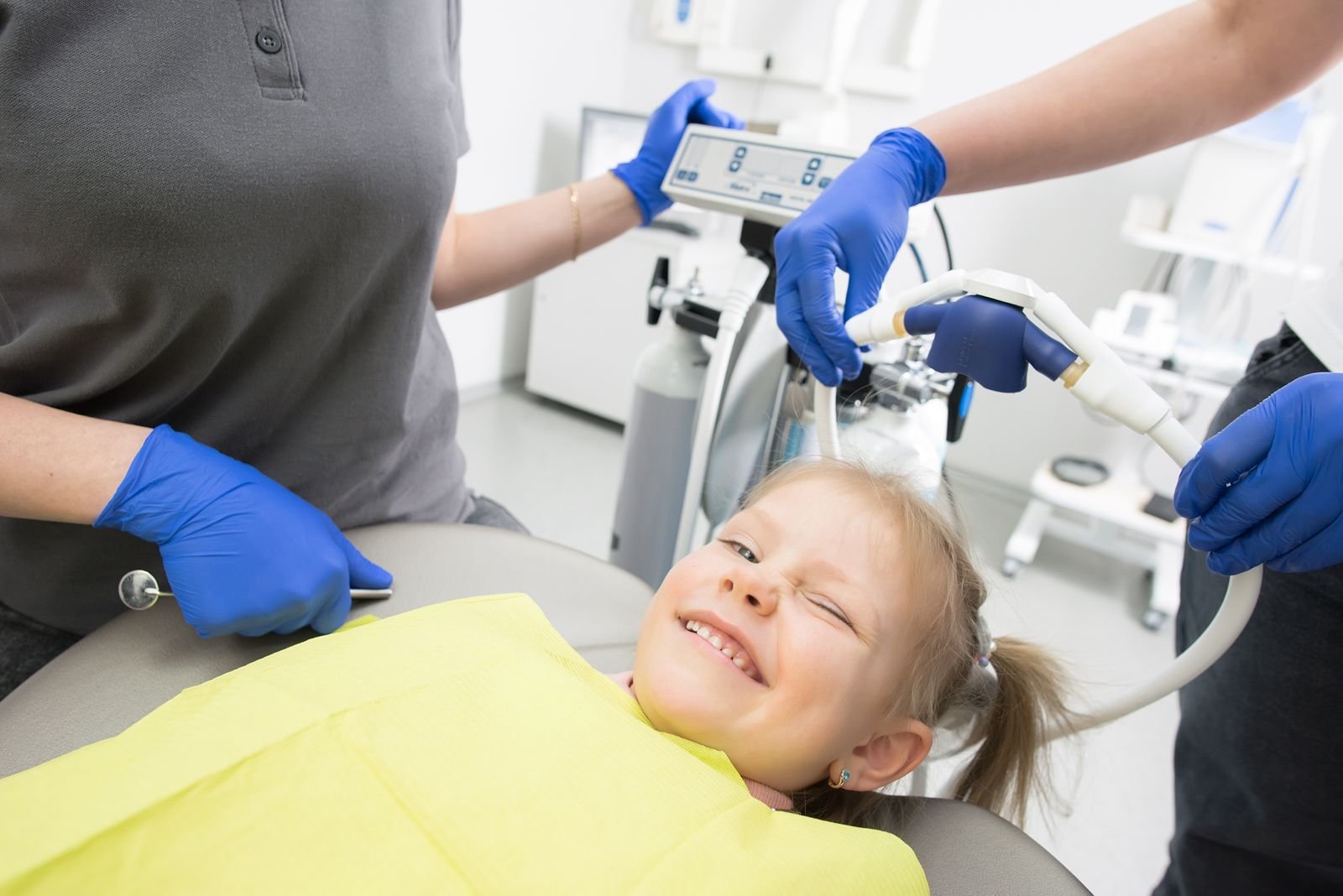
A six-year-old sits rigid in the dental chair, knuckles white on the armrests, a filling minutes away. But instead of a cartoon flickering on the ceiling, the screen shows a short, edited clip of her — walking in calmly, opening wide, getting through it just fine. She has never actually done this appointment. The video is a version of a coping self she hasn’t met yet, and an algorithm helped build it. This is the promise of AI for dental anxiety — and a new trial just tested whether it holds.
The 30-Second Version
- A 2026 randomised controlled trial tested an AI-personalised “video self-modelling” app against a standard distraction video in 80 children (ages 6–12) facing fillings.
- Both approaches significantly reduced dental fear and anxiety within each group (p < 0.001).
- On the main anxiety score (the CFSS-DS questionnaire), the AI app was no better than the ordinary video — the primary outcome showed no significant difference between groups.
- Where AI pulled ahead was the body, not the questionnaire: heart rate fell 7.65 bpm with the app versus 2.18 bpm with standard video (p < 0.001, a large effect).
It sounds like a small miracle for anxious kids and frazzled parents. But when Tasgaonkar and colleagues put it to a proper test — a single-blind, parallel-arm randomised controlled trial published in European Archives of Paediatric Dentistry — the result was more interesting, and more honest, than “AI calms children.” Eighty children aged 6–12 who needed restorative treatment were randomly assigned to either an AI-personalised video self-modelling app or a standard audio-visual aid. A blinded assessor measured their fear and anxiety before and after, using two validated scales (CFSS-DS and MCDASf) plus pulse and heart rate. The guiding question: does personalising the distraction with AI actually make children less afraid — or just look that way on a monitor?
The study, in one glance
This was an intervention trial, not a lab benchmark — the design that best tells you whether something works in real children. Both groups watched a video before their filling; only the AI group’s video was a personalised self-modelling clip. The CFSS-DS (a children’s dental fear questionnaire) was the primary outcome, with heart rate and pulse as physiological measures alongside it.
What the AI app genuinely got right
Start with what’s real and encouraging. Video self-modelling isn’t a gimmick — showing a child a short clip of themselves coping successfully is an established behavioural technique, and here AI was used to personalise it. Both interventions worked: every child, in both groups, ended the visit measurably less fearful than they started (p < 0.001). And on the body’s own stress signal, the AI app pulled clearly ahead — a heart-rate reduction of 7.65 bpm versus 2.18 bpm, a difference the authors flag as statistically significant with a large effect size (Cohen’s d = 0.89). The AI group also showed moderate-to-large improvements on specific anxiety items, particularly around injections and dental examinations — exactly the moments children dread most.
So does AI for dental anxiety actually work?
Here’s where a good trial earns its keep. The primary outcome — the CFSS-DS anxiety questionnaire — showed no statistically significant difference between the AI app and the ordinary video. Both helped; neither clearly beat the other on the measure the researchers themselves nominated as the one that mattered most. The AI’s advantage lived almost entirely in the physiological reading, not in how frightened the children reported feeling.
⚠ A quieter pulse is not the same as a braver child
Heart rate is a proxy for arousal, not a direct readout of fear. A child can have a calmer pulse and still feel just as scared — or feel calmer without the monitor budging. When the number that moved is the surrogate and the number that didn’t is the primary outcome, restraint is the honest response.
It’s a smoke detector that’s gone quieter while we’re still not sure the fire is out.
The limits are worth naming plainly. This was a single trial of 80 children, measured over a single visit — pre- and post-intervention, with no long-term follow-up to see whether the calm carried into the next appointment. Heart rate can shift for many reasons that have nothing to do with courage. And because the paper reports the app’s calming effect largely through that physiological channel, the strongest claim it supports is “reduced short-term physiological arousal” — the authors’ own careful phrasing — not “reduced dental anxiety overall.”
Can a heart-rate number be trusted to mean “less afraid”?
This is the accountability question underneath the headline. Surrogate outcomes are seductive because they’re objective and easy to chart, and a 7.65-bpm drop looks decisive on a slide. But the whole point of a validated fear scale like CFSS-DS is that it captures the experience a physiological sensor can’t. When a technology’s win shows up in the proxy and vanishes in the primary measure, the burden of proof shifts toward caution. That’s not a knock on the study — a well-designed trial being honest about a mixed result — but on any marketing that would round “lower heart rate” up to “cures dental fear.”
Who actually gets the personalised app?
An AI self-modelling tool needs a smartphone or tablet, the software, footage of the child, and a clinic willing to fold it into an already tight appointment. A plain distraction video — which performed just as well on the primary outcome — needs almost none of that. If the personalised version is meaningfully better only in a physiological signal of uncertain clinical value, the equity math gets awkward fast: we’d be adding cost, screens, and data-handling for children’s images to chase a benefit the main anxiety measure didn’t confirm. The cheaper tool being “not worse” is itself an important finding.
What this means for you
If you’re a parent
Distraction before a filling helps — that much the trial supports for both approaches. An AI-personalised app is a promising extra, not a proven upgrade; a familiar video, a calm clinician, and good preparation remain the foundation. Don’t let a “less anxious per the app” claim replace watching how your child actually copes.
If you’re a clinician
Treat AI self-modelling as an adjunct to established behaviour management, not a substitute. The evidence here is one small, single-visit trial where the app beat standard video only on heart rate, not the primary anxiety scale. Worth watching; not yet worth reorganising your paediatric protocol around.
The bottom line
This trial is a model of the kind of result the hype cycle tends to flatten. AI personalisation quieted children’s bodies but not, measurably, their reported fear — and both the app and a plain video helped. The most useful takeaway isn’t “AI calms kids”; it’s that a well-run study can tell the difference between a moving number and a meaningful one. The app is an assistant to behaviour management, not an oracle of a child’s inner state.
Frequently asked questions
What did the study actually find?
In 80 children aged 6–12, both an AI-personalised video self-modelling app and a standard distraction video significantly reduced dental fear and anxiety. The AI app did not beat the standard video on the primary anxiety questionnaire (CFSS-DS), but it produced a larger drop in heart rate (7.65 vs 2.18 bpm, p < 0.001).
Is “video self-modelling” just watching a cartoon?
No. Self-modelling shows a child a short, edited video of themselves successfully coping with a task — a recognised behavioural technique. In this trial, AI was used to personalise that clip, versus a standard audio-visual distraction aid in the comparison group.
Does a lower heart rate mean my child is less scared?
Not necessarily. Heart rate is a physiological signal of arousal that can change for many reasons; it is not a direct measure of fear. In this study the main psychological measure of anxiety showed no significant difference between the groups, so the calmer pulse should be read cautiously.
Should dental clinics adopt AI self-modelling now?
It’s promising but early. The evidence is one small, single-centre trial measuring a single visit, where the AI app outperformed standard video only on heart rate. Larger, longer studies are needed before it replaces proven behaviour-management methods.
Source & author credit
This article interprets, and does not reproduce, the following peer-reviewed study. All figures are the authors’ original findings, drawn from the study’s published abstract. We covered a related paediatric AI question in whether ChatGPT gives sound paediatric-dentistry answers.
Tasgaonkar A, Rathi N, Tasgaonkar M, Agrawal P, Tapkir A, Mehta V. A randomised controlled trial comparing effectiveness of audio-visual aid and AI-personalised video self-modelling interventions to reduce dental fear and anxiety in paediatric patients. European Archives of Paediatric Dentistry. 2026;27(5):1561–1571. DOI: 10.1007/s40368-026-01241-8
ORCID — none were listed in the source record for the authors of this article; we do not invent identifiers.
Copyright © 2026 the authors, published by Springer Nature; used here under fair-use commentary for education. Decadentry is an independent educational publication and is not affiliated with the study’s authors. Reviewed under Decadentry’s editorial standards.



Leave a Reply