

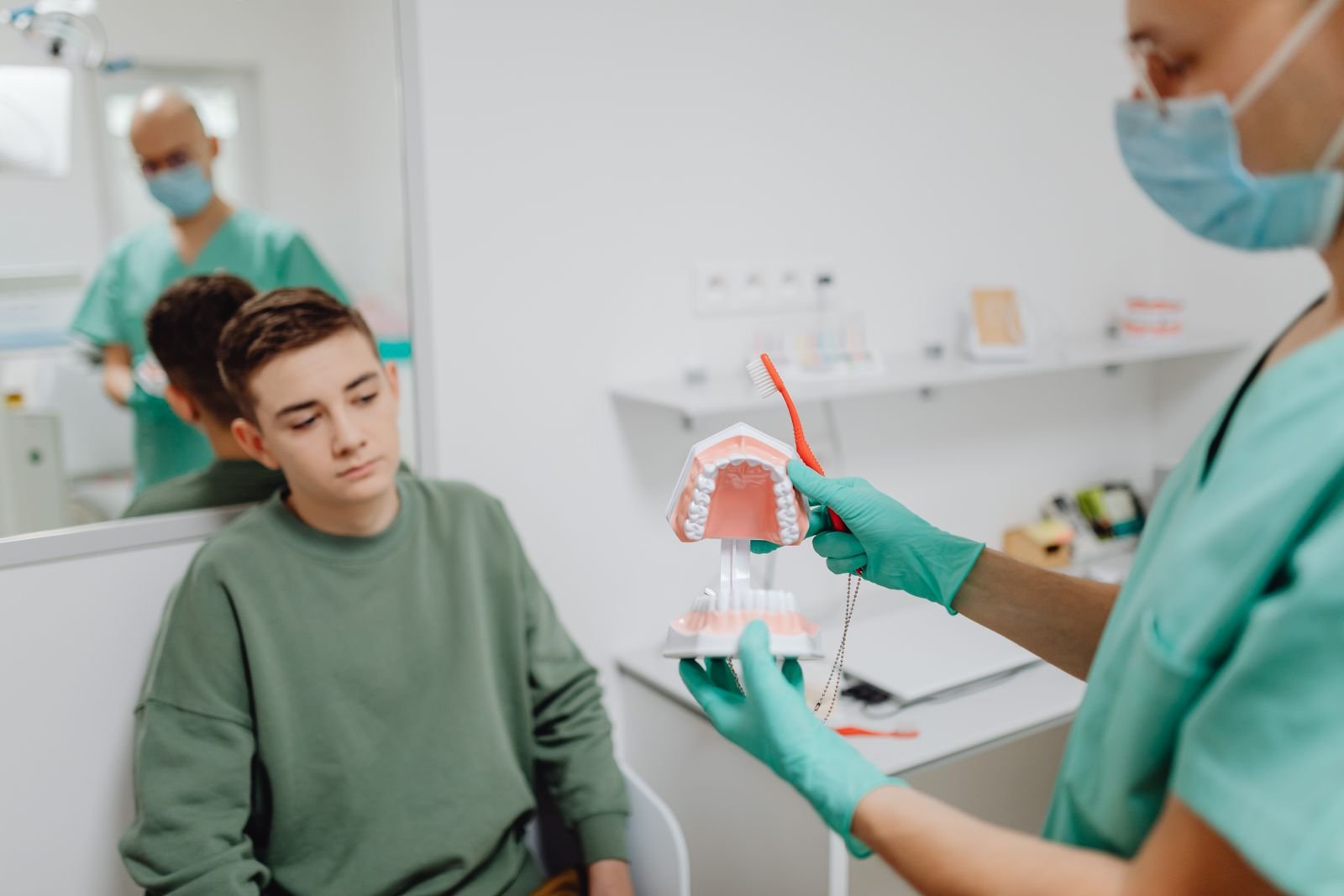
It’s 1 a.m. before a prosthodontics exam, and a final-year dental student doesn’t reach for a textbook. They open ChatGPT. A new five-country survey suggests that scene is no longer the exception — it’s the norm, and it reframes what AI in dental education actually looks like day to day.
The 30-Second Version
- A survey of 454 senior dental students across the UAE, Jordan, Malaysia, Oman and Brazil found large-language-model use is near-universal: 95.9% use ChatGPT, and about two-thirds use a chatbot several times a week or daily.
- Students mostly use it to save time, understand hard concepts and summarise lectures — but roughly 1 in 4 admitted using an LLM to help during exams.
- Only 20.0% say they “always” verify what the AI tells them; just over half (54.1%) verify “always or often.” Heavier users were not more sceptical.
- The honest caveat: this is self-reported survey data, one institution per country (two in the UAE), so it captures what students say they do — not whether the AI’s answers were correct.
It sounds like a straightforward productivity win. But a 2026 study in Medical Education Online by Abubaker Qutieshat and nine colleagues decided to measure it properly. Using an anonymous cross-sectional survey, they asked 454 final-year dental students in five countries not just whether they use chatbots, but how, how often, and — crucially — whether they check the answers. The guiding question wasn’t “do students use AI?” Everyone knows they do. It was: what kind of habit is AI in dental education actually becoming?
The study, in one glance
This was a questionnaire study, not a test of accuracy. The team surveyed senior undergraduate dental students across six institutions (two in the UAE; one each in Jordan, Malaysia, Oman and Brazil), covering the tools they use, how often, why, which study tasks they lean on AI for, how they judge its reliability, whether they verify it, and what they do to stay on the right side of academic integrity. The sample was 74.9% female with a mean age of 22.9; familiarity with LLMs as a concept was 94.2%. ChatGPT dominated (95.9%), far ahead of Gemini (18.0%), DeepSeek (16.4%) and Claude (7.4%).
What AI in dental education actually delivers
Strip away the alarm and there’s a real upside here. The students’ top motivations were saving time (73.0%), clarifying difficult concepts (56.9%) and generating quick summaries (54.1%). In practice they used LLMs to understand complex concepts (75.3%), summarise lecture notes (70.0%), prepare for exams (61.5%) and research assignments (53.2%). The perceived payoff was mostly positive: 63.6% felt they saved time overall, 55.8% believed their academic outcomes improved, and — strikingly — not a single respondent said their outcomes got worse. Used this way, an LLM behaves like an always-available tutor for the explanatory layer of learning: rephrasing a dense paragraph on adhesive protocols, walking through an endodontic access sequence, or compressing a two-hour lecture into something you can review on the bus.
But who’s checking the answers?
Here’s where the promise frays. Only 20.0% of students said they “always” verify what an LLM tells them; adding the “often” group gets you to 54.1%. That leaves a large minority — 17.3% “rarely” and 3.2% “never” — taking AI output largely on faith. More telling, heavier use didn’t buy more caution: frequency of use correlated with the breadth of tasks students threw at AI (Spearman’s ρ = 0.289) but had no meaningful link to how much they worried about integrity (odds ratio 0.963, not significant). Exposure, in other words, bred familiarity — not scepticism.
⚠ Confident, fluent, and sometimes wrong
LLMs don’t just occasionally err; they can fabricate citations that look perfectly real and state outdated guidance in an authoritative tone. In a field where evidence traceability is everything, a plausible-but-invented reference is more dangerous than an obvious mistake — because it’s the kind a hurried student won’t think to check.
An LLM is like a GPS that occasionally invents a road: fine when you already know the city, genuinely risky when you’re still learning to navigate.
And it’s novices who are most exposed. The students least able to catch a subtle clinical error are precisely the ones still building the knowledge to catch it — yet the survey suggests their verification routines are the least developed. The authors are blunt that critical thinking in an AI world is less about generating answers and more about supervising, interrogating and validating them, and that this has to be taught, not assumed to appear through sheer exposure.
Is “academic integrity” the same as honesty here?
Most students did report at least one integrity safeguard — but look closely at which. The common moves were paraphrasing or rewriting (69.6%), using “humanising” tools (43.1%), adding citations (39.2%) and running plagiarism checkers (38.0%). The rarest? Actually disclosing that AI helped, via a disclaimer — just 9.2%. The authors read this as a telling pattern: the effort goes into transforming and legitimising text rather than into transparency and evidence traceability. It’s integrity as a cleanup step, not integrity as honest sourcing — and the two are not the same thing.
Does every student even get the same rulebook?
No — and that may be the quietest finding with the loudest implications. Awareness of any institutional AI guidelines was just 40.3% overall, with 28.3% reporting none and 31.3% unsure. The spread between settings was enormous: 61.3% of UAE students knew their rules versus 8.3% in Brazil. Verification habits and higher-stakes use varied the same way (the Oman cohort, for instance, verified less often than the others). The researchers are careful to call these “country-based institutional cohorts,” not national verdicts — but the lesson holds regardless of borders. When the guidance a student receives is this uneven, the same AI tool becomes a supported learning aid in one classroom and an unsupervised free-for-all in another. That’s an equity problem dressed up as a technology story.
What this means for you
If you’re a patient
The dentist who treats you in a few years almost certainly trained with AI as a study aid — mostly to understand material, which isn’t a bad thing. What matters is whether their school taught them to verify and to keep their hands-on skills sharp. Tactile control and clinical judgement can’t be summarised by a chatbot, and this study doesn’t claim they can.
If you’re a clinician or educator
The debate over whether to “allow” LLMs is already over — your students use them several times a week. The live question is whether you teach verification, source-checking and disclosure as explicit skills, and whether your assessments are designed for a world where AI is in the room. Banning it quietly just moves it underground.
The bottom line
This survey doesn’t show that AI is ruining dental education, and it doesn’t show it’s saving it. It shows something more useful: a generation that has adopted a powerful assistant far faster than anyone taught them to supervise it. The tool isn’t the problem — the missing instruction manual is. An LLM can be a brilliant study partner for a student who treats it as an assistant to be checked, and a quiet liability for one who treats it as an oracle to be trusted. The difference is entirely in the training.
Frequently asked questions
What did this study actually measure?
It was an anonymous survey of 454 final-year dental students in the UAE, Jordan, Malaysia, Oman and Brazil, asking how they use large language models like ChatGPT — which tools, how often, for what tasks, and whether they verify the answers. It measured self-reported behaviour and attitudes, not whether the AI’s answers were accurate.
Is it a problem that dental students use ChatGPT so much?
Not inherently. Most use was for understanding concepts, summarising notes and exam prep, and students reported real time savings. The concern is narrower: only 20% said they always verify what the AI tells them, and heavier users weren’t more careful — so the risk sits with unverified reliance, not use itself.
Do students check whether the AI is right?
Unevenly. About 54% verify “always or often,” but 20.5% verify rarely or never, and verification habits varied widely between institutions. Because LLMs can produce fluent, confident errors and even fabricated citations, inconsistent checking is the study’s central worry — especially for novices still building the knowledge to spot a mistake.
Will this make future dentists less skilled?
The study can’t answer that — it’s a snapshot, not a long-term follow-up, and perceived impact on critical thinking isn’t the same as measured skill. But it flags the right risk: AI supports the knowledge-and-explanation side of training, while the tactile, visual and clinical-judgement skills of dentistry still have to be built through supervised practice.
What do the authors say schools should do?
Move past ad-hoc messaging toward explicit, skills-based training in verifying claims, tracing evidence to primary sources and disclosing AI use — backed by clear, enforceable guidelines and assessments designed for the reality that students already use these tools.
Source & author credit
This article interprets, and does not reproduce, the following peer-reviewed study. All figures are the authors’ original findings. Decadentry articles are checked against their primary source under our editorial standards; related reading: AI in Dental Education: Better Than a Lecture — or a Tutor? and our Ethics, Education & Patient Care hub.
Qutieshat A, Annamma LM, Singh G, Arzmi MH, Wan Ahmad Kamil WN, Khasawneh L, Varma SR, Carneiro Leão J, George BT, Alrashdan MS. Large language model use in dental education: a cross-sectional multi-country study. Medical Education Online. 2026;31(1):2707729. DOI: 10.1080/10872981.2026.2707729
ORCID — Qutieshat 0000-0002-3569-6576; Annamma 0000-0003-3304-2541; Singh 0009-0002-4985-6902; Arzmi 0000-0002-9470-6412; Wan Ahmad Kamil 0000-0002-2393-0425; Khasawneh 0000-0002-8338-1501; Varma 0000-0001-6793-9344; Carneiro Leão 0000-0001-6576-2055; George 0000-0001-5029-7779; Alrashdan 0000-0003-2512-1557.
Published open access under a Creative Commons Attribution 4.0 (CC BY 4.0) licence. Decadentry is an independent educational publication and is not affiliated with the study’s authors.


Leave a Reply