
Sit in the chair with an aching molar and one question hangs over everything: is this tooth worth saving, or does it come out? Two dentists can look at the same film and give you two different answers — and the one you get can decide whether you keep your own tooth or pay for an implant.
The 30-Second Version
- A new deep-learning model judged AI tooth restorability — keep or extract — from a single X-ray, scoring 94.74% accuracy on its test set.
- Six specialists built the scoring rubric first, and agreed with each other strongly (κ = 0.87) — the human benchmark the model was chasing.
- Its AUC was a more sober 0.888, which tells you the easy calls flatter the headline number and the close calls stay hard.
- The honest caveat: it reads one flat radiograph, was never tested outside its own dataset, and a real save-or-pull decision needs the mouth, not just the picture.
It sounds like the end of a very old argument. But the question is being asked by a specific study: Rafif Alshenaiber and fifteen colleagues, writing in the International Dental Journal, trained a convolutional neural network to predict whether a tooth is restorable from a parallel periapical radiograph alone. Their guiding question was blunt — can a model take the subjectivity out of one of dentistry’s hardest everyday calls?
The study, in one glance
First the humans. Six dental specialists developed a restorability prediction score from parallel periapical X-rays, then independently read a sample of 1,300 radiographs to see whether they agreed. They did: intra-examiner agreement came in at a Cohen’s kappa of 0.84 and inter-examiner at 0.87 — “strong” by the usual reading. That agreement matters, because the humans’ labels became the answer key. The team then screened 53,035 anonymised radiographs, built a model on a modified VGG16 architecture, and split the data 70:20:10 — 37,125 images to train on, 10,607 to tune, and 5,303 held back to test.
Why a consistent second opinion would genuinely help
Start with what’s good here, because it’s real. The save-or-extract decision is notoriously subjective — the authors say so themselves — and it drifts with a clinician’s training, their speciality, and frankly how busy the chair is that afternoon. A tool that looks at the same film every time and gives the same answer could pull some of the noise out of that. And the model wasn’t scored against a casual guess: it was scored against six specialists who agreed with one another strongly, which is a stiffer test than most dental-AI papers set themselves. Hitting 94.74% accuracy against that bar, on thousands of test images, is a result worth taking seriously.
Does 94.74% mean what it sounds like?
Here’s the catch, and it’s buried in the gap between two numbers. Accuracy was 94.74%, but the model’s AUC — the measure that doesn’t depend on where you set the cut-off — was 0.888 (95% CI 0.871–0.904). Those tell different stories. A headline accuracy is a snapshot at one chosen threshold, and it climbs easily when a dataset is full of clear-cut cases: the shattered, hopeless root and the pristine, obviously-restorable tooth are easy for anyone, human or machine. AUC is the harder exam, because it reflects how well the model separates the genuinely borderline teeth across every threshold. An 0.888 is good — but it’s the quiet admission that the close calls, which are exactly the ones you’d want help with, stay close.
⚠ One film is not the whole mouth
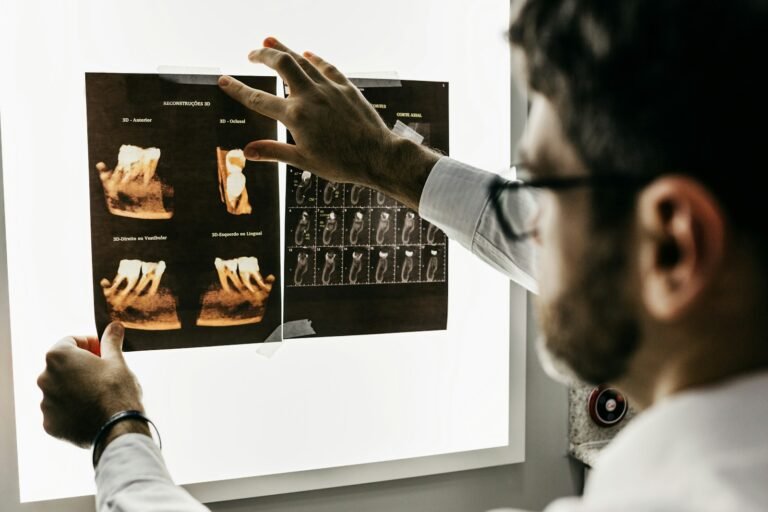
The model saw a single two-dimensional periapical X-ray. A real restorability call also weighs tooth mobility, gum-pocket depth, how much sound structure survives below the gum line, bite forces, decay the film can’t show, and what the patient actually wants. The study’s own framing is a “preliminary” and “supportive” tool — not a verdict.
A radiograph is a shadow of a tooth. You can learn a lot from a shadow — but you don’t pull a tooth because of one.
The other limit is where the evidence stops. The whole model — training, tuning and testing — was built and checked on one dataset, drawn from one country. There’s no sign it was ever shown radiographs from a different clinic, a different X-ray machine, or a different population, and that external test is the one that tells you whether a model travels. Dental AI is littered with tools that scored beautifully at home and stumbled the moment they left. Until this one is tested somewhere else, 94.74% is a home-field number.
Whose answer key is it, really?
There’s a subtler point about what “accuracy” even means here. The model wasn’t checked against what happened to those teeth years later — whether the saved ones survived or the extracted ones truly had to go. It was checked against the specialists’ judgments. So the model learned to agree with expert opinion, not to be right about outcomes. That’s a reasonable place to start, and the strong inter-rater agreement makes the target a fair one. But it means the ceiling of this tool is a very good consensus of six dentists — including whatever that consensus gets wrong. It can make the average call more consistent; it can’t yet promise it makes the call more correct.
Who benefits, and who gets left out?
If this matures, the winners are patients seen by less experienced dentists, or in settings where a specialist opinion is a long drive away: a consistent restorability score could flag the teeth worth a second look before anyone reaches for the forceps. The risk runs the other way for anyone whose teeth don’t resemble the training set. A model trained on one population’s radiographs, on one set of machines, has no proven footing elsewhere — and restorability thresholds are not neutral. Lean toward “extract” and you nudge people toward implants they may not be able to afford; lean toward “restore” and you may chase a tooth that was never going to last. A tool that sets that dial deserves to be tested on the people it will actually judge.
What this means for you
If you’re a patient
An AI restorability score, if your dentist ever uses one, is a prompt for a conversation, not a sentence passed on your tooth. If you’re told a tooth must go, it’s fair to ask what the call rests on beyond the X-ray — mobility, gum health, how much tooth is left — and a second opinion remains your right.
If you’re a clinician
Read this as a consistency aid scored against expert consensus, not against long-term outcomes, and not yet externally validated. The accuracy-versus-AUC gap is the tell: lean on it for the obvious cases, keep your own hands on the borderline ones, and treat a single periapical as one input among several.
The bottom line
This model does something useful and modest: it turns a flat X-ray into a repeatable opinion that mostly matches what good specialists already think. That’s an assistant, not an oracle. The save-or-extract decision will stay a human one for a while yet — because it was never really a question about the picture. It was always a question about the whole mouth, and the person attached to it.
Frequently asked questions
Can an AI decide whether my tooth should be saved or pulled?
Not on its own. In this study a deep-learning model predicted tooth restorability from a single periapical X-ray and matched specialist judgments about 94.74% of the time on its test set. But it reads only a flat image, was tested on one dataset, and the authors describe it as a preliminary, supportive tool. The decision still belongs to a clinician examining the whole mouth.
Why does 94.74% accuracy come with an AUC of only 0.888?
They measure different things. Accuracy is performance at one chosen cut-off and rises when a dataset holds many obvious cases. AUC (0.888, 95% CI 0.871–0.904) is threshold-independent and reflects how well the model separates the genuinely borderline teeth. The gap suggests the model handles clear cases easily but the close calls — the ones where help would matter most — stay difficult.
What can’t a radiograph show about restorability?
A lot. A two-dimensional X-ray doesn’t capture how loose a tooth is, how deep the gum pockets are, how much sound structure remains below the gum line, the forces from biting and grinding, early decay hidden on the image, or the patient’s own priorities. All of these shape a real save-or-extract decision, which is why the model is positioned as support, not a verdict.
Is this tool ready to use in clinics?
No. The model was trained, tuned and tested on a single dataset from one country, with no reported external or multi-centre validation — the test that shows whether a model holds up on new machines and new populations. It also learned to agree with expert opinion rather than to predict long-term tooth survival. It’s a promising proof of concept that needs outside testing before any clinical role.
Source & author credit
This article interprets, and does not reproduce, the following peer-reviewed study. All figures are the authors’ original findings.
Alshenaiber R, Abozaed HW, Alzahrani B, AlShehri K, Alnafisah F, Alharbi R, Alzobidi A, Alshehri A, Aldekhayyil M, Hashem Q, Albader S, Aljulayfi I, Alabdulsalam Z, Mudhaffer S, Tayeb H. Deep-Learning Artificial Intelligence Model for Tooth Restorability Using Radiographic Assessment. International Dental Journal. 2026;76(6):111115. DOI: 10.1016/j.identj.2026.111115
ORCID — Rafif Alshenaiber 0000-0002-3872-0834; Heba Wageh Abozaed 0000-0002-3216-7361; Bandar Alzahrani 0009-0003-2036-3669; Khalid AlShehri 0009-0009-8841-7196; Shaymaa Mudhaffer 0009-0007-2159-0029; Hunaida Tayeb 0009-0000-0262-9214.
Published under a CC BY-NC-ND 4.0 licence; headline figures are abstract-verified against the published record (DOI confirmed to resolve; ORCIDs from Crossref). Decadentry is an independent educational publication and is not affiliated with the study’s authors. For how we check every article, see our editorial standards, browse more endodontics & restorative explainers, or read our related piece on AI restorative planning.
Leave a Reply