

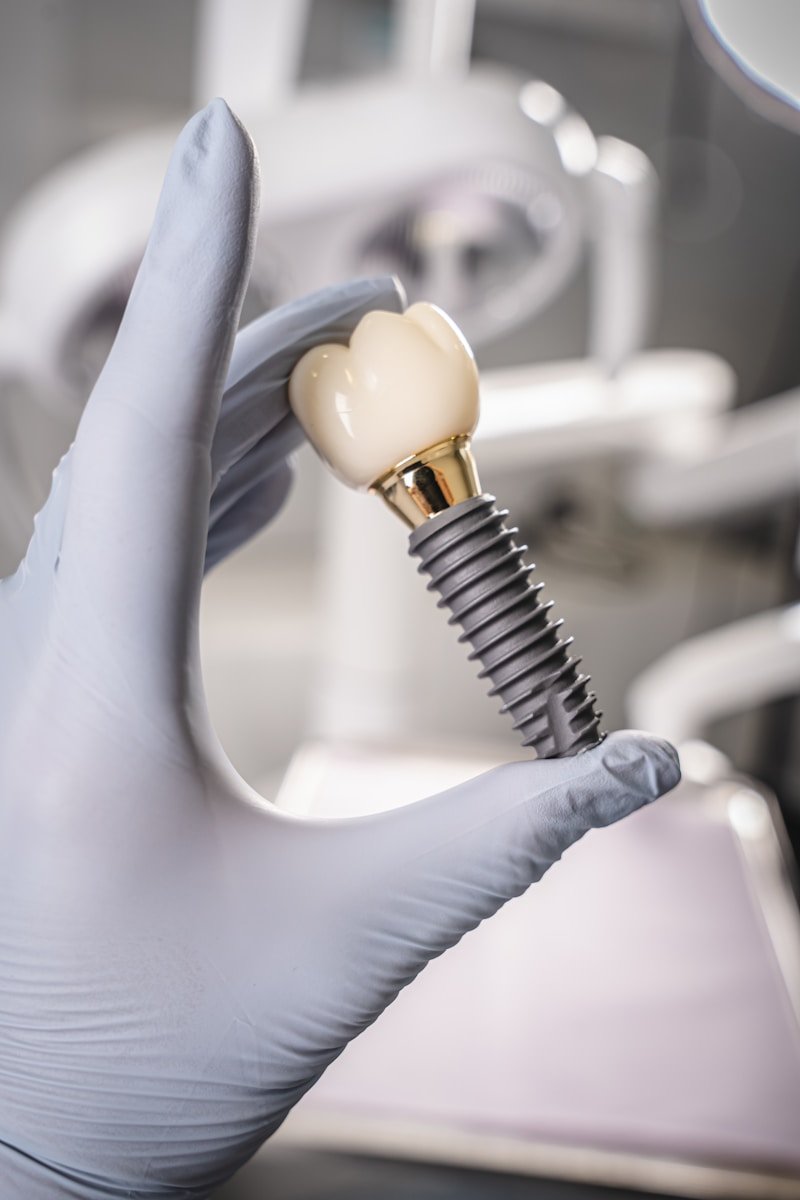
Sit in the chair for one missing tooth, and the plan behind your implant is invisible to you. A specialist scrolls through a cone-beam scan and mentally threads a titanium screw between a nerve, a sinus, and two paper-thin walls of bone — three-dimensional judgment that takes years to build. A system called ImplantPlanNet tried to draft that first pass on its own. This is AI implant planning put to a hard test: remarkably close on where the implant should go, noticeably shakier on what size it should be.
The 30-Second Version
- A deep-learning framework, ImplantPlanNet, drafted single-tooth implant plans straight from CBCT scans, then was scored against specialists’ reference plans.
- On familiar-type scans it landed the implant tip within ~1.8 mm and ~5.6° of the expert plan; on unfamiliar scans it drifted to ~2.2 mm and ~6.9°.
- Choosing the right implant diameter was perfect internally (100%) but fell to 75% on new scans, and length was only 65% correct in both.
- The honest caveat: 144 scans, single-tooth gaps only, one dataset for training — a proposal for a clinician to check, not an autopilot.
It sounds like the operatory of the future. But look closely at the paper. Writing in the Journal of Dentistry (2026), Juan Yang, Qihang Liu, Hongjie Yang and colleagues built ImplantPlanNet to answer a narrow, honest question: can a model take a preoperative CBCT of a single missing tooth and propose a sensible starting plan — position, angle, length, and diameter — that a clinician can then refine? The right way to judge it isn’t whether it looks impressive. It’s whether its mistakes are the kind you’d catch before the drill ever touches bone.
The study, in one glance
The team trained the system on 104 CBCT scans of single-tooth gaps, tuned it on 20 more, and — crucially — tested it two ways: 20 internal scans that resembled the training data, and 20 external scans held out as a tougher, unfamiliar batch. ImplantPlanNet works in stages: locate the candidate site, crop a local 3D patch, estimate the implant’s pose (where it sits and which way it points), then recover its length and diameter. Every prediction was scored against a specialist’s reference plan using 3D coronal and apical deviations, angular deviation, size-classification accuracy, and safety distances to nearby structures.
The promise of AI implant planning: near-specialist aim
Where the machine genuinely shone was geometry. On the internal test set, the implant’s coronal (crown-end) position landed 1.53 ± 0.80 mm from the specialist’s plan, the apex sat 1.77 ± 0.82 mm off, and the long-axis angle was within 5.55 ± 3.39°. Even on the harder external scans those numbers held up — 1.67 mm at the crown, 2.21 mm at the tip, 6.92° in angle — and internally it picked the correct diameter every single time. For a first draft generated in seconds from a raw scan, aiming that consistently is a real achievement.
So why wouldn’t you just let it plan your implant?
Because of sizing. The same model that aimed like a specialist could not reliably choose how big the screw should be. Implant-length classification was correct only 65% of the time in both the internal and external sets — roughly one length pick in three was wrong. Diameter accuracy, a flawless 100% on familiar scans, dropped to 75% on unfamiliar ones. A near-miss on size is not the rounding error it looks like on a spreadsheet.
⚠ A near-miss on size is not a near-miss in the mouth
An implant one length category too long can push toward the maxillary sinus floor or the inferior alveolar nerve canal; one diameter too wide can thin or blow out the surrounding bone. These are the exact structures a plan exists to protect — so the parameter the model was weakest on is also the one with the least room for error.
It’s like an architect who places the staircase perfectly but keeps ordering the beams a size off — the drawing looks right until you try to build it.
The validation limits sharpen the point. The whole study rests on 144 scans, single-tooth gaps only — no multi-tooth spans, no severely resorbed ridges. Tellingly, on the external set the AI’s plans left the buccal (cheek-side) bone plate slightly thinner than the specialists’ did — a subtle safety flag, since the buccal wall is exactly where implants tend to fail. And every “accuracy” number is measured against a human’s reference plan, not against how the implant actually performed in a real jaw.
If the AI drafts the plan, who owns the mistake?
To their credit, the authors never pitch this as an autopilot; they describe ImplantPlanNet as generating an initial plan “for clinician review.” That’s honest — but it quietly hands the clinician a hard job: catching a plausible-looking wrong answer. A plan that aims perfectly and confidently proposes the wrong implant length is more dangerous than an obviously bad one, because it invites the reviewer to nod along. The safeguard against automation bias isn’t in the model; it’s in the human who stays skeptical of a tool that’s right most of the time. It’s the same tension we found when a language model tried to plan implants from guidelines and text in our look at retrieval-augmented AI implant planning — more polished output, no better spatial judgment.
Who gets this — and who gets left out?
The external-test drop is a preview of the real world. Models trained on one center’s scans and one population tend to wobble the moment the data shifts — a different CBCT machine, a differently shaped jaw. Practices with the newest scanners and cleanest data would see the best of a tool like this; everyone else inherits the degradation the external set already showed. And by design it handles only the single-tooth case, leaving out the complex, bone-deficient situations where less-experienced clinicians most need a second opinion.
What this means for you
If you’re a patient
An AI first draft may speed up your consultation, but a human still decides the implant that goes into your jaw. It’s fair to ask whether your plan was checked against your own scan — especially the implant’s length and width, the parts the technology is least sure about.
If you’re a clinician
Treat a tool like this as a time-saver for the routine single-tooth case, not a shortcut. Scrutinize the size classifications first, watch the buccal plate on unfamiliar scans, and don’t stretch it to spans or resorbed ridges it was never trained on.
The bottom line
ImplantPlanNet is a promising draftsman, not a surgeon. It can rough in where a single implant should go with near-specialist precision — but until it can size the screw as reliably as it aims it, and until it’s proven across many machines, many jaws, and real surgical outcomes, it belongs on the clinician’s screen as a proposal to challenge, not a plan to trust.
Frequently asked questions
What is ImplantPlanNet?
It’s a deep-learning framework, described in a 2026 Journal of Dentistry study, that reads a preoperative CBCT scan of a single missing tooth and proposes an initial implant plan — position, angle, length, and diameter — for a clinician to review and refine.
How accurate was the AI implant planning?
Against specialists’ reference plans, it placed the implant within about 1.5–1.7 mm at the crown end, 1.8–2.2 mm at the tip, and 5.6–6.9° in angle. Diameter choice was 100% correct on internal tests but 75% on new scans, and implant length was 65% correct in both sets.
Can AI plan my dental implant by itself?
No. The study tested single-tooth cases only, on 144 scans, and the authors present the output as a proposal for clinician review, not an autonomous plan. A qualified clinician remains responsible for the final plan and the surgery.
Why did the model’s accuracy drop on the external test?
The external scans were deliberately unfamiliar. Placement stayed close, but size classification weakened and the AI’s plans left the buccal bone slightly thinner than specialists’ — a sign the model does not yet generalize reliably across different data.
Is this being used in dental clinics now?
Not as a standalone tool. It’s an early feasibility framework that still needs validation across multiple centers, more complex cases, and real surgical outcomes before it could be trusted in everyday practice.
Source & author credit
This article interprets, and does not reproduce, the following peer-reviewed study. All figures are the authors’ original findings.
Yang J, Liu Q, Yang H, Liu Y, Liao P, Chen H. ImplantPlanNet: A deep learning framework for automatic implant planning from preoperative CBCT images. Journal of Dentistry. 2026;175:106925. DOI: 10.1016/j.jdent.2026.106925
ORCID — Qihang Liu (0009-0002-9360-5596); Hongjie Yang (0000-0002-5364-2133).
© 2026 Elsevier Ltd. Published under Elsevier’s user license; Decadentry reproduces no copyrighted text or figures. Decadentry is an independent educational publication and is not affiliated with the study’s authors.

Leave a Reply