

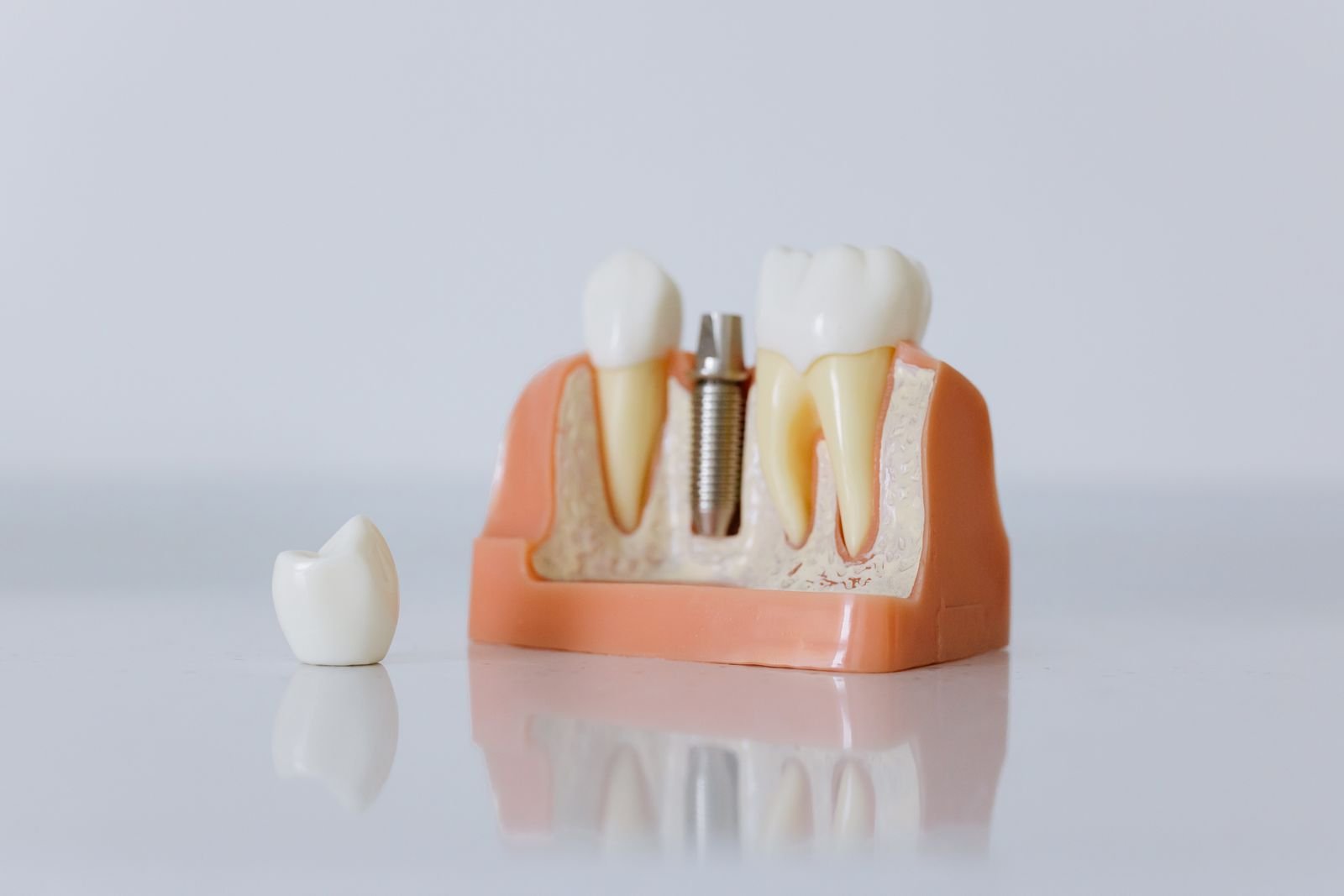
A patient sits down in your chair with an implant that is quietly failing. It was placed abroad a decade ago, there is no paperwork, and to order the right replacement part you first have to answer a deceptively hard question: which implant is this? That guess — brand, then component — is exactly what AI dental implant identification is now being built to make for you, straight from an X-ray.
The 30-Second Version
- A German in-vitro study trained a two-stage AI to tell four implant systems apart on radiographs — two original brands and their near-identical generic copies.
- On the test images, the AI classified every implant correctly (100%), while 61 dentists and dental students averaged 86.6%.
- It matters because a missing implant record can mean the wrong replacement part — and a repair that fails before it starts.
- The honest caveat: this was a lab study with just four implant types and clean images. Real clinics face hundreds of systems and far messier films.
It sounds like a solved problem. But the details are where it gets interesting. In a study published in the Journal of Dentistry in 2026, Mark K. Bremer and colleagues at University Medical Center Mainz built a two-stage system — a Mask R-CNN to find and cut out the implant on the radiograph, then a transfer-learned ResNet-50 to classify it — and trained it on 1,384 standardized radiographs. Then they did something many AI papers skip: they put the machine head-to-head with real humans on the same task, and asked not just who was right, but how sure each was.
The study, in one glance
The design was a controlled, ex-situ comparison. Four implant types were used — two from original manufacturers and two matching generic (compatible) systems designed to look almost the same on film. After training on 1,384 radiographs, the AI was validated on a separate test set. In parallel, 61 dental students and dentists assessed a set of 98 radiographs, producing 2,322 individual ratings, and each rater also reported how confident they were in every call as a percentage.
The real promise of AI dental implant identification
Telling implants apart is harder than it sounds. Original systems and their generic copies are engineered to look alike, and on a two-dimensional radiograph the distinguishing threads and collars can be a fraction of a millimeter. That is where the machine shone: across the test set it made no classification errors, significantly beating the humans (p < 0.001). Just as telling, the researchers found that a human’s clinical experience and gender had no significant effect on whether they got it right — but their self-reported confidence did (p < 0.001). In other words, the dentists who felt sure were more often correct, which is reassuring for human judgment but also a reminder that a machine with a perfect memory for hardware carries no such doubt. If you have ever hunted through catalogs to match an unknown fixture — the same detective work that makes AI-guided implant planning so tempting — you can see the appeal.
But can it work outside the lab?
Here is the catch the headline number hides. This was an in-vitro study using standardized, ex-situ radiographs of just four implant types under controlled conditions. The machine was choosing from a closed menu it had already memorized. Real practice is nothing like that: large reference datasets have catalogued well over a hundred implant systems, and clinical films come warped by angulation, wear, bone, and overlapping crowns.
⚠ A closed menu, not the real world
The AI only had to pick among four options it was trained on. Show it a fifth, unknown brand — the everyday reality of a patient who had an implant placed abroad — and a classifier like this is forced to sort it into one of the buckets it knows. A confident wrong answer is worse than an honest “I don’t recognize this.”
It is like a bird-identification app that knows exactly four species: flawless when the bird is one of them, and quietly misleading the moment it isn’t.
The authors themselves stress that clinical validation in real-world settings is still needed before routine use. That means testing on films from many machines, on worn and partially obscured implants, and — critically — across far more systems than four, with a way to flag the unfamiliar rather than guess.
Who is accountable if the AI names the wrong implant?
Implant identification is not a trivia question; it drives a purchase and a procedure. Match the wrong system and a clinician may order an incompatible abutment or screw, risking a repair that loosens or fractures. So the sensible framing is decision support: the AI narrows the field and flags a likely match, and the clinician confirms it against records, the surgical site, and — where they exist — implant registries before committing to a part. The machine’s confidence is not a substitute for that verification, and responsibility for the final choice stays with the human ordering the component.
Who gets this — and who is left with a guess?
The patients who need this most are often the ones least likely to benefit from it. Implant “tourism” and lost paperwork are common precisely where documentation is thin, and national implant registries remain rare. A tool like this could be a genuine equalizer for a clinic facing an undocumented fixture — but only if it is trained on an open, shared, and broad catalog of systems rather than a handful, and made available beyond well-resourced academic centers. Built narrowly, it risks working best exactly where good records already exist.
What this means for you
If you’re a patient
Keep your implant card or “passport” and ask your dentist to note the brand and reference number. If you don’t have it, an AI tool may help a clinician narrow down what you’re carrying — but treat that as a lead to confirm, not a final answer.
If you’re a clinician
This is a promising triage aid for undocumented implants, not a replacement for records or physical verification. Watch for the closed-set trap: know what the model was trained on, and be most skeptical when it sounds most certain about an unfamiliar case.
The bottom line
A machine that never forgets a fixture is a real asset in a field where paperwork goes missing. But this study proved it on a four-item menu under lab lighting. Until it can say “I don’t recognize this” across hundreds of real-world systems, it is a fast, tireless assistant for narrowing the search — not an oracle you order parts from.
Frequently asked questions
Can AI identify my dental implant brand from an X-ray?
In this 2026 study it could — but only among four implant types it had been trained on, using standardized lab radiographs. It was not tested on the full range of systems used in real clinics, so it is not yet a general-purpose identifier you can rely on for any implant.
How accurate was the AI compared with dentists?
The AI classified the implants without error (100%) on the test set, significantly outperforming 61 dentists and dental students, who averaged 86.6% accuracy (p < 0.001). Among the humans, self-reported confidence predicted accuracy, while clinical experience and gender did not.
Does this mean AI implant identification is ready for the clinic?
No. It was an in-vitro study with only four implant types and pristine images, and the authors say real-world clinical validation is still required. The main gap is the “closed set” problem: the model chooses among brands it knows and can’t yet reliably flag an unfamiliar one.
Why does knowing the implant brand even matter?
Different implant systems use different abutments, screws, and connections. Ordering a part for the wrong system can lead to a poor fit and a failed repair, so correctly identifying an undocumented implant is a real, practical problem — especially for patients who had implants placed elsewhere with no records.
Source & author credit
This article interprets, and does not reproduce, the following peer-reviewed study. All figures are the authors’ original findings.
Bremer MK, Hoffmann NP, Schmalbach B, Abou-Ayash S, Blume M, Kianusch K, Hartmann A, Petrowski K, Bjelopavlovic M. Radiological differentiation of original and generic dental implants using a multiclass AI model in comparison with human expertise: an in vitro study. Journal of Dentistry. 2026;175:106945. DOI: 10.1016/j.jdent.2026.106945
ORCID — Monika Bjelopavlovic: 0000-0003-1478-1680
Published open access under a Creative Commons Attribution 4.0 (CC BY 4.0) license. Decadentry is an independent educational publication and is not affiliated with the study’s authors. Editorial and sourcing standards: About & Editorial Standards.

Leave a Reply