

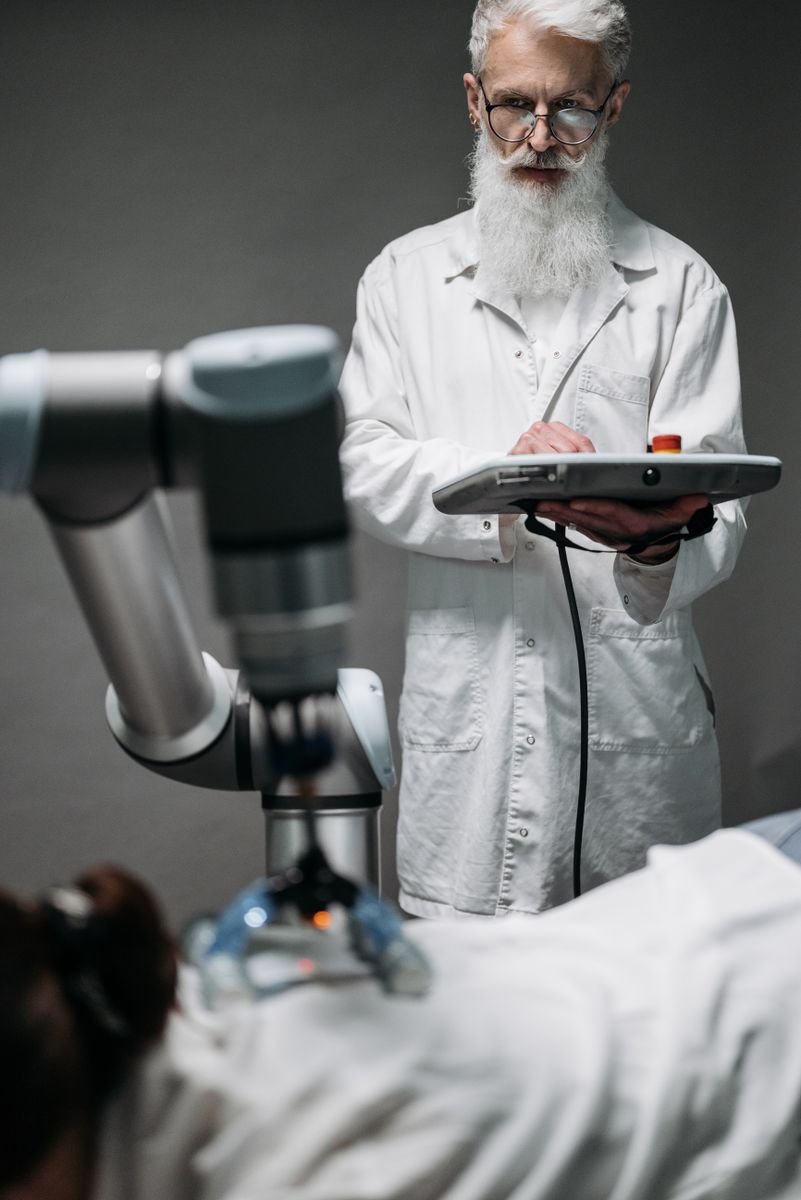
Picture an operating room where no one is holding the drill. A robotic arm rotates, pauses, finds its angle, and drives a four-centimetre titanium screw up through the cheekbone toward the eye socket — while the surgeon stands back and watches. That is the promise of an autonomous dental implant robot, and a new laboratory study just put one to the test on the single most demanding implant in dentistry.
The 30-Second Version
- A fully autonomous robot (Yakebot) placed 40 zygomatic implants in plastic jaw models with no human hand on the drill.
- Precision was tight: mean deviation of 0.87 mm at the entry point, 1.26 mm at the deep tip, and 1.22° in angle.
- But the models cracked at 8 of 40 sites — one in five — and this was rigid resin, not living bone with soft tissue, bleeding, and a breathing patient.
- It is one in-vitro study of a single commercial system, with no comparison to human surgeons and no clinical validation — impressive engineering, not clinical readiness.
It sounds like the future of oral surgery has arrived. But look closely at what was actually tested. Writing in the Journal of Dentistry, researchers Nhan Van Vo and Khang Gia Tran Vo report on a fully autonomous robotic system placing zygomatic implants — the long implants anchored not in the jaw but in the cheekbone — and ask a pointed question: can a machine be trusted to place the riskiest implant in dentistry entirely on its own?
The study, in one glance
The team built ten identical edentulous (toothless) upper-jaw resin models from one patient’s scan data, and gave each four zygomatic implants — at tooth positions #14, #16, #24, and #26 — for 40 in total. The robot (Yakebot, from a Beijing firm) planned and executed every placement autonomously. Accuracy was scored as the deviation between the planned and achieved position at four points: neck (entry), apex (deep tip), angulation, and depth. Because the resin cracked at eight sites during drilling, only 32 implants reached the final analysis.
What the autonomous dental implant robot got right
The headline numbers are genuinely good. Across the 32 analysed implants, mean deviations were 0.87 ± 0.49 mm at the neck, 1.26 ± 0.42 mm at the apex, 1.22 ± 0.50° in angulation, and just 0.06 ± 0.65 mm in depth. More than nine in ten placements (90.6%) landed within 1.5 mm at the neck, and about two-thirds stayed within 1.5 mm and 1.5° at the deeper, harder-to-hit apex. A robot does not tire on the fortieth screw, its hand never trembles, and it drills to the same plan every time — and for a procedure this unforgiving, that consistency is the whole point.
And it really is unforgiving. Zygomatic implants are a last resort for people whose upper jaw has too little bone for ordinary implants — after long-term tooth loss, trauma, or cancer surgery. Placing one means driving a long screw on a steep path into the cheekbone, threading between the sinus and the orbit, and only a handful of surgeons do it well. Planning that path is one problem — we have covered AI that drafts implant plans from a CBCT scan before — but executing it, drill in bone, is another. A robot that reliably carried out an expert’s plan might one day spread a scarce skill far beyond the few clinics that offer it.
But was it placing implants — or drilling plastic?
Here is the catch no accuracy figure can paper over: every implant went into resin. Ten models copied from one patient means zero anatomical variability — no differences in bone density, no thin spots, no awkward angles a real skull throws at a surgeon. There was no soft tissue to retract, no blood to obscure the field, no patient who breathes or flinches under the drape. Living bone is springy and uneven; cured resin is uniform and brittle. The robot was solving a cleaner problem than any operating room presents.
⚠ One in five sites cracked
Cracks appeared at 8 of the 40 drilling sites, and those implants were simply dropped from the analysis. In a lab model that is a discarded data point; in a person’s cheekbone — millimetres from the eye and sinus — a fracture or an off-target trajectory is a serious surgical complication. A 20% structural-failure rate is not a rounding error. It is a warning light.
It is a self-parking car that nails the space every time — in an empty lot, with painted lines, no pedestrians, and the same car parked ten times over. Genuinely clever. But not yet rush hour.
The evidence base is also thin by design: a single-centre, in-vitro study of one commercial robot, with no head-to-head comparison against a human surgeon — so we cannot say whether it beats, matches, or trails the experts it might replace. Nor was accuracy uniform: both angular and depth deviation differed significantly by tooth position (p < 0.05), meaning the robot was measurably better at some spots in the arch than others.
If the robot slips, who answers for it?
“Fully autonomous” is the phrase that should make everyone slow down. It means the machine executes the drilling and placement itself, following a plan, without a hand guiding the instrument in real time. A human surgeon who makes an error owns it — professionally, ethically, and legally. When an autonomous system drills a few millimetres off, into anatomy where a few millimetres is the whole margin of safety, the lines of accountability blur. Regulators, insurers, and professional bodies are still writing the rules for autonomous surgery, and this study — impressive as the engineering is — does nothing to settle them.
Would this reach the patients who need it most?
Zygomatic implants disproportionately serve older, medically complex, and often lower-income patients — the people most affected by long-term tooth loss and least able to travel to a specialist centre. In principle, a robot could democratise the procedure, putting expert-level placement within reach of ordinary clinics. In practice, a system like this is expensive, and expensive technology tends to land first in high-end urban practices. Whether robotic surgery narrows the access gap or widens it depends far less on the accuracy figures than on who ends up owning the machines.
What this means for you
If you’re a patient
This is not something you can book — it is a laboratory proof of concept, tested on plastic, with no real patients yet. If a clinic ever offers you “robotic” implant surgery, ask a simple question: is the robot assisting a surgeon or acting on its own, and what is the evidence in real people?
If you’re a clinician
Read this as early engineering validation, not a green light. Sub-millimetre means on uniform resin, with a 20% cracking rate and no human comparator, tell you the platform is promising, not ready. Watch for the in-vivo, multi-centre trials with surgeon benchmarks that will actually decide it.
The bottom line
A machine that never tires and drills exactly to plan is a powerful assistant. But zygomatic surgery is judgment as much as geometry — reading the bone under the burr, adjusting when the field bleeds, knowing when to stop. Until an autonomous system proves itself in living bone, in real patients, with a surgeon clearly accountable for the outcome, this is an assistant still in training — not an oracle with a drill.
Frequently asked questions
What is a zygomatic implant, and why is it so hard to place?
It is an extra-long dental implant anchored in the zygomatic bone (the cheekbone) rather than the jaw. It is used for patients with too little upper-jaw bone for standard implants. The trajectory runs close to the sinus and the eye socket, so an error of a few millimetres can cause serious harm — which is why only a small number of surgeons perform it routinely.
How accurate was the robot?
On 32 analysed implants in resin models, mean deviations were 0.87 mm at the entry neck, 1.26 mm at the deep apex, 1.22° in angle, and 0.06 mm in depth, with most placements within 1.5 mm and 1.5°. These are strong lab numbers — but they were measured in plastic, not people.
Can I get robotic zygomatic implant surgery now?
No. This is a single in-vitro study on models, with no patients treated and no clinical validation. It shows the technology is promising, not that it is ready for care.
What is the study’s biggest limitation?
It was plastic, not people: ten identical models from one patient, with no soft tissue, bleeding, or patient movement. On top of that, the model cracked at 8 of 40 sites, and there was no comparison against human surgeons.
Is the robot really “autonomous”?
Yes — it executes the drilling and placement to a plan without a hand guiding the instrument in real time, under a surgeon’s supervision. But the accountability, regulatory, and liability frameworks for autonomous surgery are still being written.
Source & author credit
This article interprets, and does not reproduce, the following peer-reviewed study. All figures are the authors’ original findings.
Vo NV, Vo KGT. Accuracy assessment of a fully autonomous robotic system for zygomatic implant placement: An in vitro study. Journal of Dentistry. 2026;175:106803. DOI: 10.1016/j.jdent.2026.106803
ORCID — Nhan Van Vo: 0000-0001-6966-9886
© 2026 Elsevier Ltd., Journal of Dentistry — all rights reserved. This is a copyrighted subscription article; Decadentry summarises and interprets it and does not reproduce its text or figures. Reported statistics were checked against the study’s published record. Written and fact-checked by Hossein Boustani Hezarani under Decadentry’s editorial standards. Decadentry is independent and not affiliated with the study’s authors.

Leave a Reply