

Your periodontist looks at your gums, your X-rays, your history of bleeding and bone loss, and makes a quiet bet: this tooth will still be here in ten years, that one probably won’t. For nearly half a century, researchers have tried to turn that bet into a formula — and lately, into an algorithm. So why does AI gum disease prediction still rest on models that almost all fail a basic test of trustworthiness?
The 30-Second Version
- A 2026 systematic review in the Journal of Clinical Periodontology critically appraised 27 prognostic models for periodontitis built between 1979 and 2025.
- Of the 20 models formal enough to score, all but one landed at high risk of bias — and even that one was rated only “unclear.”
- The weak spot is the statistical analysis: 19 of 20 scorable models stumbled on validation, missing-data handling, and how predictors were used.
- Newer machine-learning models are better documented than the old scorecards — but “better than before” is not the same as “ready to trust with your teeth.”
It sounds like exactly the kind of problem AI should own: feed a model your probing depths, bone levels, smoking status and genetics, and let it tell you which teeth are in trouble. But a new critical appraisal says the field has a credibility gap. Maryia Karaban, Andrea Ravidà and colleagues at the University of Pittsburgh and collaborators in Italy ran a systematic review of every periodontitis prognostic tool they could find — 27 models spanning 1979 to 2025 — and scored the scorable ones with PROBAST, the standard checklist for judging whether a prediction model can be believed. The guiding question was not “which model is best?” but something more uncomfortable: are these models even built well enough to answer that?
The study, in one glance
The team searched three databases, screened 1,605 records, and settled on 27 studies. They sorted them into three eras of thinking: conceptual tools (n=7, 1979–2010) that proposed risk frameworks with no patient data; category-based tools (n=9, 1980–2015) that slotted patients into low/moderate/high risk boxes; and data-driven models (n=11) built from real patient data using statistics or machine learning. PROBAST could only be applied to the 20 models with actual data behind them; the 7 purely conceptual frameworks had nothing empirical to grade.
AI gum disease prediction: the genuine progress
Read the review charitably and there’s a real success story inside it. Periodontal prognosis has evolved from gut-feel risk categories toward quantitative, individualized probability estimates — the kind of output a modern AI model produces. The newest data-driven models increasingly do the things good prediction science demands: they report internal validation, they publish calibration metrics (not just “how often is it right?” but “when it says 70%, does 70% actually happen?”), and a handful now test their model on an entirely separate group of patients. One model even layered cross-validation during development on top of external validation. The strongest PROBAST domain across all 27 studies was Participants — 11 of them earned a clean “low risk” rating for using appropriate, well-defined patient cohorts. The raw ingredients, in other words, are often fine.
So why do nearly all of them fail?
Because the cooking is where it falls apart. Overall, every category-based tool and almost every data-driven model was rated high risk of bias; only a single study (Troiano et al.) escaped with an “unclear” rather than “high.” The damage was concentrated in one PROBAST domain — Analysis — where 19 of the 20 scorable models were rated high risk and just one scraped a “low.” That domain is the statistical engine room: how continuous measurements are handled, whether missing data is dealt with honestly, whether there are enough real disease events to support the number of predictors, and above all whether the model was ever validated.
⚠ A prediction you can’t check is just a confident opinion
Only 4 of the 20 scorable models assessed their predictors without already knowing the outcome — meaning most risk a subtle circularity, where the “prediction” is quietly informed by what the researchers already know happened. And external validation, the real test of whether a model works on patients it has never seen, remained rare.
A prognostic model without external validation is a weather forecast that has only ever been tested on yesterday.
The authors also note something sobering about the field’s trajectory. TRIPOD — the reporting standard meant to drag prediction research toward transparency — came out in 2015. Methodological improvement after TRIPOD was, in their word, “modest.” The tooling to do this right exists. It just isn’t being used consistently.
Does “high risk of bias” mean the models are wrong?
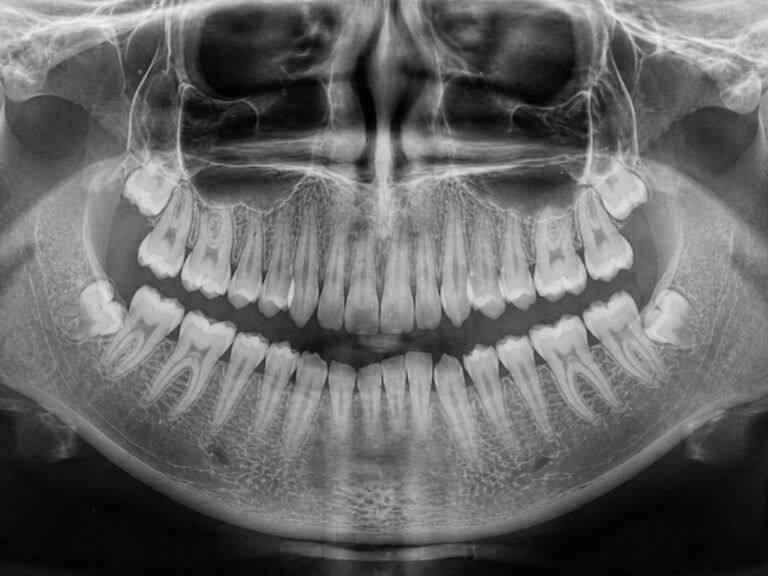
No — and this is where honesty cuts both ways. PROBAST measures how a study was built and reported, not whether its predictions happen to be accurate. A high-risk rating is a flag that says “we cannot be confident this will generalize,” not “this is false.” Some of these tools, especially the long-standing category systems, remain clinically useful and historically important; they simply weren’t designed to the evidentiary bar we now expect. The review deliberately did not crown a best model. Its point is narrower and more durable: before you trust any periodontitis predictor — human-made scorecard or neural network — ask whether it has been validated on patients who aren’t in its own training data. For most of them, the answer is still no. (We saw the same validation gap in AI systems that stage and grade gum disease from panoramic X-rays — strong in the lab, thin on real-world proof.)
Who does this leave exposed?
Prognostic models are quietly consequential. They can decide whether a shaky tooth gets an expensive implant now or a few more years of watchful care; whether a patient is told they’re “high risk” and nudged toward frequent, costly maintenance; whether insurance or a treatment plan leans one way or the other. A model built and validated on one clinic’s long-term-maintenance patients may misread someone from a very different background — and because most of these tools skipped external validation, we rarely know in advance where they’ll be unreliable. The burden of a bad prediction doesn’t fall on the algorithm. It falls on the person in the chair.
What this means for you
If you’re a patient
If a tool or app gives you a “gum disease risk score,” treat it as a conversation starter, not a verdict. Ask your dentist what it’s based on and whether it’s been tested on patients like you. The fundamentals still predict your future better than any score: bleeding, pocket depth, bone loss, smoking, and whether you keep your maintenance visits.
If you’re a clinician
Before adopting a prognostic model, check its PROBAST-style pedigree: Was it externally validated? Is calibration reported, not just discrimination? Were predictors assessed blind to the outcome? If those boxes are empty, use it to support your judgment — never to overrule it.
The bottom line
After 46 years and 27 models, periodontal prognosis has better data and better documentation than ever — and still almost no models you could call trustworthy without caveats. AI doesn’t fix that by being cleverer; it fixes it by being validated. Until then, a risk score is an assistant whispering a probability, not an oracle naming your fate. The job of the clinician is to listen, then check.
Frequently asked questions
Can AI predict whether I’ll lose a tooth to gum disease?
Models exist that estimate the risk, and the newest machine-learning versions are better documented than older scorecards. But a 2026 systematic review found that of 20 scorable periodontitis prognostic models, all but one were at high risk of bias — mostly because they were never validated on independent patients. So any single prediction should be treated as guidance, not a guarantee.
What does “high risk of bias” actually mean?
It’s a rating from PROBAST, a checklist that judges how a prediction model was designed and reported — not whether its answers happen to be correct. A high-risk rating means we can’t be confident the model will work reliably on new patients. It’s a warning about trust, not proof the model is wrong.
Why is external validation such a big deal?
A model tested only on the data it was built from can look impressive and still fail on real, different patients — like a forecast only ever checked against the day it was made from. External validation means testing the model on an entirely separate group. In this review, that step was still rare, which is the core reason most models can’t yet be trusted.
Are older paper-based gum-disease risk tools useless, then?
No. Category-based systems that sort patients into low, moderate, or high risk remain clinically and historically valuable; they just weren’t built to today’s statistical standards. The review’s message isn’t “throw them out” — it’s “know their limits and don’t mistake a risk category for a validated individual prediction.”
Source & author credit
This article interprets, and does not reproduce, the following peer-reviewed study. All figures are the authors’ original findings. According to PubMed.
Karaban M, Dias DR, Troiano G, Baniameri S, Ahuja I, Joseph D, Serroni M, Ravidà A. Methodological Quality of Prognostic Models for Periodontitis: A Systematic Review and Critical Appraisal. Journal of Clinical Periodontology. 2026;53(10):1513-1528. DOI: 10.1111/jcpe.70180
ORCID — Karaban 0000-0001-5537-7276; Dias 0000-0002-5387-1753; Troiano 0000-0001-5647-4414; Baniameri 0000-0002-5575-629X; Ahuja 0009-0001-6017-0568; Joseph 0009-0007-8354-6146; Serroni 0000-0002-2081-6651; Ravidà 0000-0002-3029-8130
Published open access under a Creative Commons Attribution 4.0 (CC BY 4.0) licence. Decadentry is an independent educational publication and is not affiliated with the study’s authors. Source retrieved via PubMed/PMC. Written and fact-checked by Hossein Boustani Hezarani — see our editorial standards.

Leave a Reply