

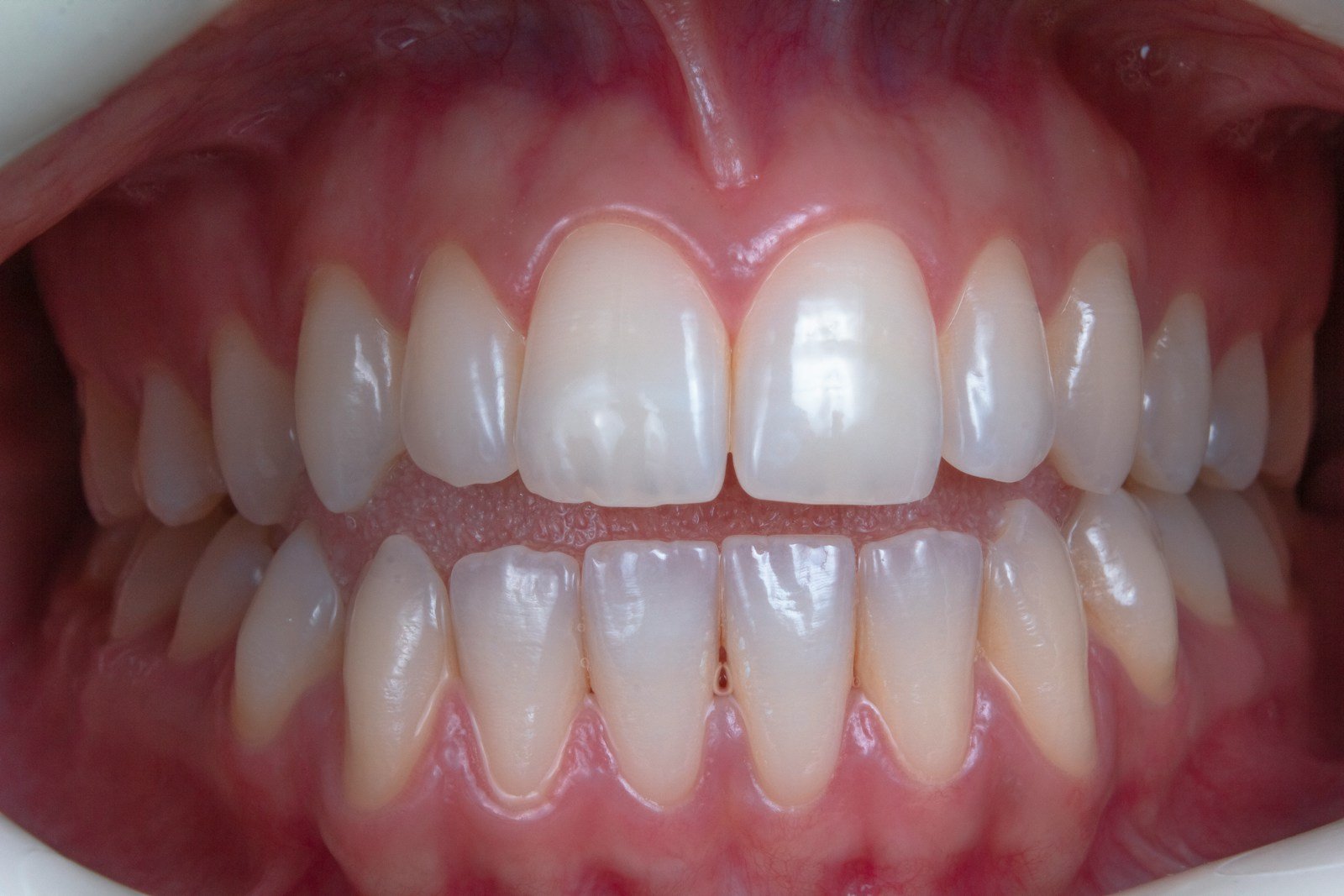
You pick a shade tab, the dentist holds it to your tooth and squints, the lab technician frowns at a photo on a monitor, and three weeks later your new front tooth glows one notch too bright under the bathroom light. Matching the color of a single tooth is one of the quietest headaches in dentistry — and AI dental shade matching is the latest attempt to take the guesswork out of it.
The 30-Second Version
- A new system called PerceptShade estimates tooth shade from ordinary intraoral photos taken on smartphones or cameras, under everyday lighting rather than a controlled studio.
- Across 50 fresh cases, its first-choice shade agreed with a three-expert consensus 76.0% of the time — slightly ahead of the 72.7% agreement among the independent human experts.
- Its top-three suggestions contained the right shade 96.44% of the time, which makes it look stronger as a shortlist than as a single verdict.
- The honest caveat: it was judged against photos and an expert panel — not a spectrophotometer or the finished crown — still needs a reference tab in the frame, and comes from one group’s data.
It sounds like the end of the mismatched veneer. But the details matter. In a study published in the Journal of Dentistry in 2026, Ran Tao, Jian Wang and colleagues at Sichuan University built PerceptShade and tested it on 1,553 shade-matching images from 357 patients, then ran a head-to-head observer study on 50 new cases. The guiding question isn’t “is the AI impressive?” — it clearly is. It’s whether an AI that matches a panel of experts on photographs is the same thing as an AI that will get the color of your tooth right.
The study, in one glance
PerceptShade is an image-based framework that borrows the way clinicians actually judge color: it looks at non-specular tooth regions (skipping the glare), makes a brightness-first judgment the way shade guides are taught, and learns perceptual similarity rather than raw pixel values. It was trained and evaluated on 1,553 images from 357 patients captured on a mix of smartphones and digital cameras under heterogeneous lighting. A separate set of 50 prospectively collected cases was used to compare its top pick against both a reference panel’s consensus and the individual expert observers.
Why AI dental shade matching is harder than it looks
Shade matching is a problem that punishes human eyes. The same tooth looks different under daylight, the chair lamp, and your kitchen bulbs — a trick of physics called metamerism. Observers get tired; the eye adapts after a few seconds of staring; and two dentists can disagree on the same tooth, which is exactly what the 72.7% expert-versus-expert agreement in this study quietly admits. Spectrophotometers are more consistent but fussy about angle and contact, and not every practice owns one. Against that messy backdrop, a tool that reads a routine photo and hands back a ranked shortlist is genuinely useful. PerceptShade’s standout number isn’t its top pick at all — it’s that the right answer sat in its top three a remarkable 96.44% of the time. As a “here are the three shades worth comparing at the chair” assistant, that is a strong result.
But was it measured against the right yardstick?
Here is the catch that the headline hides. PerceptShade wasn’t judged against a spectrophotometer, and certainly not against the finished, cemented restoration a year later. It was judged against a panel of human experts looking at the same photographs — and experts, as the study itself shows, only agree with each other about three times out of four. Matching a reference that is itself uncertain is a lower bar than matching the physical truth of the tooth. And even on that bar, the AI’s single best guess was wrong roughly one time in five (Top-1 accuracy 79.12% on the main test set; 76.0% agreement in the observer study). For a front tooth, “wrong one time in five” is not a number you want to discover at cementation.
⚠ It still needs a reference tab, and it comes from one source
PerceptShade requires a physical shade tab in the frame to anchor its reading — so it is not yet a “snap a selfie, get your shade” consumer tool. And the whole dataset came from a single institution’s workflow, with a 95% confidence interval on that 76.0% figure running from 61.8% all the way to 86.9%. That is a wide band built on just 50 observer cases.
Think of it as a weather app that’s excellent at narrowing tomorrow down to one of three forecasts — you still bring the umbrella to the chair.
None of this makes PerceptShade a weak study — it makes it an early one. What it has not yet done is the thing that separates a clever prototype from a clinical tool: external validation on photos from other clinics, other cameras, and other patient populations, measured against an objective color standard rather than a panel of eyes. Until then, the performance figures should be read as promising-in-house, not proven-in-the-wild.
Who is accountable when the color is wrong?
A mismatched shade is rarely a safety emergency, but it is expensive, disheartening, and sometimes means remaking the restoration. If an AI suggested the shade and it came out wrong, the responsibility still sits with the clinician who accepted the suggestion — which is as it should be. The right mental model here is a shortlist, not a decision. PerceptShade’s job is to narrow the field and reduce the odds that a tired eye at 4pm misses the obvious; the final call, and the accountability, stay human. Tools that present themselves as a ranked top-three rather than a single confident verdict make that division of labor honest.
Does it work on every smile?
This is where image-based shade AI has the most to prove. A model trained on one population’s teeth, cameras, and clinic lighting may not transfer cleanly to teeth with fluorosis, heavy staining, existing restorations, or simply a different natural shade distribution than the training set. On the other hand, the photo-first approach is quietly democratic: if it can eventually work from a standardized clinical photo plus a reference tab, it could bring more consistent shade guidance to practices and teledentistry setups that will never own a spectrophotometer. Whether that promise reaches everyone depends entirely on whether the next studies test it on everyone — which, so far, they have not.
What this means for you
If you’re a patient
If your dentist uses an AI shade tool, treat it as good news, not magic: it widens the net so the best-matching shades get compared at the chair. It doesn’t replace the moment where you check the color in natural light and speak up if something looks off. Your eye in your own bathroom is still part of the quality check.
If you’re a clinician
A 96.44% top-three hit rate is a real workflow win for narrowing candidates, especially late in a long day. But the single top pick was right only about four times in five against a consensus that itself agreed only 72.7% of the time — and the tool still needs a reference tab and hasn’t been externally validated. Use it to shortlist, verify against your standard, and keep the final shade call yours.
The bottom line
PerceptShade is a sharp, clinically-minded assistant that matched a panel of experts on photographs — and even edged them. But matching uncertain human eyes on in-house images is not the same as nailing the physical color of your tooth, and a system that’s right one time in five less than perfectly is a co-pilot, not an oracle. The most useful thing it does isn’t deciding the shade. It’s making sure the right shade is in the conversation.
Frequently asked questions
Can AI now pick my tooth shade from a phone photo?
Partly. PerceptShade estimates shade from routine intraoral photos taken on smartphones or cameras under everyday lighting, but it still needs a physical reference shade tab in the frame to anchor the reading. It is a clinical assistant, not a “snap a selfie and get your shade” consumer app.
How accurate was the AI shade matching?
In the observer study, the AI’s single best shade matched a three-expert consensus 76.0% of the time, slightly ahead of the 72.7% agreement among the human experts. Its top-three suggestions contained the correct shade 96.44% of the time, and its Top-1 accuracy on the main test set was 79.12%.
Does that mean it’s better than a dentist at choosing color?
Not exactly. It was compared to experts judging the same photographs, not to a spectrophotometer or the finished restoration, and experts only agreed with each other about three times out of four. The AI edged that benchmark, but the confidence intervals overlap, so the win is modest rather than decisive.
Is it ready for routine use in my dental clinic?
Not yet as a standalone. The data came from a single institution, the sample for the head-to-head test was small (50 cases), and there is no external validation on other clinics, cameras, or patient populations. The authors frame it as support for shade selection, not a replacement for clinical judgment.
Could AI shade matching help with teledentistry?
Potentially. Because it works from standard photos rather than expensive hardware, a validated version could bring more consistent shade guidance to remote and under-resourced settings. That benefit depends on future studies testing it across diverse teeth and lighting conditions first.
Source & author credit
This article interprets, and does not reproduce, the following peer-reviewed study. All figures are the authors’ original findings, verified against the published abstract and record.
Tao R, Feng H, Liao P, Li R, Li H, Chen H, Wang J. AI framework for dental shade matching under variable lighting conditions. Journal of Dentistry. 2026;173:106746. DOI: 10.1016/j.jdent.2026.106746
ORCID — No public ORCID iDs were listed for this article’s authors in the Crossref record at the time of writing.
© 2026 Elsevier Ltd. Published in the Journal of Dentistry under a standard Elsevier license; Decadentry reproduces no part of the original text or figures and interprets the findings for a general audience. Decadentry is an independent educational publication and is not affiliated with the study’s authors. Read our editorial standards.
Leave a Reply