

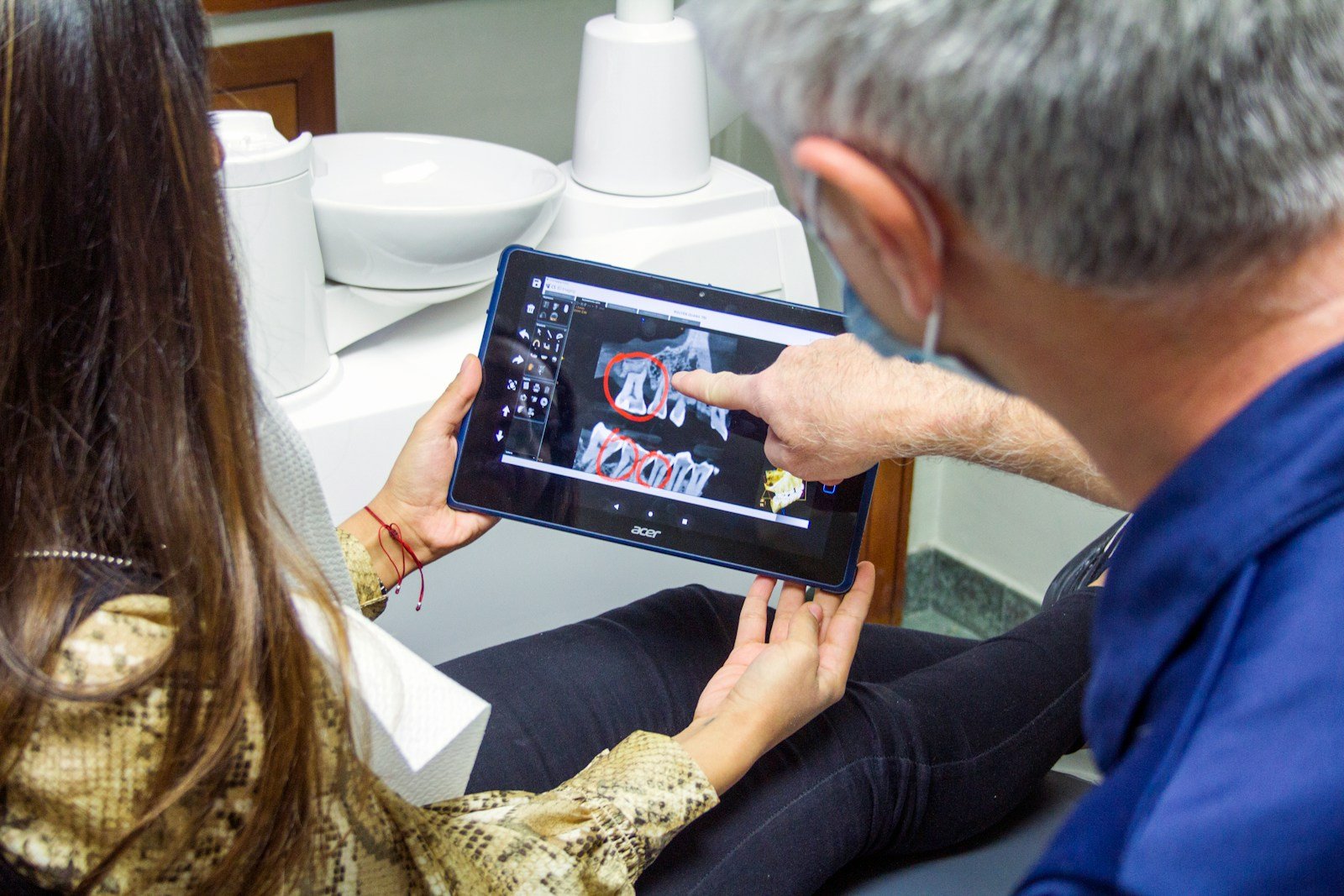
A dentist three years out of school sits down with a panoramic X-ray and misses roughly a third of the cavities hiding in it. A seasoned colleague across the hall catches far more. Now switch on a quiet overlay that outlines the suspect teeth — and the newcomer’s read starts to look a lot like the veteran’s. That gap between beginner and expert, and whether AI-assisted caries detection can shrink it, is exactly what a new multicentre study set out to measure.
The 30-Second Version
- A 2026 multicentre reader study in the International Dental Journal tested a dual-stage AI tool on 402 panoramic radiographs, read by 12 early-career and 3 senior dentists.
- With AI assistance, early-career dentists’ tooth-level sensitivity jumped from 67.4% to 82.4% — catching more decay — while specificity held at about 97%.
- They also read each case roughly 15 seconds faster, agreed with one another more (κ 0.61→0.73), and all 12 improved.
- The honest caveat: all three centres were in China, the “gold standard” was itself a panoramic read, and case-level false alarms stayed high — so this is decision support, not a verdict.
It sounds like the great equaliser. But in a study published in 2026 in the International Dental Journal, Yujia Wu and colleagues ran the test that marketing decks usually skip: a proper reader study. Across three tertiary centres in China, fifteen dentists — twelve with three years’ experience or less, three with more than ten — each interpreted the same 402 anonymised panoramic radiographs, first on their own and then with a dual-stage U-Net system highlighting suspected lesions. A panel of three experts, agreeing closely with one another (Fleiss’ κ = 0.82), set the reference standard. The guiding question was pointed: can an overlay narrow the performance gap that experience usually buys?
The study, in one glance
This was not a new scanner or a flashy model demo — it was a controlled test of whether AI changes what real dentists see. Of the 402 radiographs (mean patient age 39.5), 229 (57.0%) contained caries, and at the tooth level just 447 of 11,172 teeth (4.0%) were carious — a realistically sparse target. Readers worked under four conditions: unassisted, AI-assisted, AI-only, and the expert reference. The AI overlay drew colour-coded contours but no confidence scores, could be toggled on or off, and could not be edited; the final call always belonged to the dentist. A four-week washout separated the two reading sessions to blunt recall.
What AI-assisted caries detection got right
Taken at face value, the gains are the kind clinicians actually care about. Early-career dentists’ tooth-level sensitivity climbed from 67.4% to 82.4% — a 15-point jump — while specificity barely moved (97.2% to 97.4%). In plain terms: they found more real decay without crying wolf more often. The overall diagnostic accuracy (area under the ROC curve) rose from 0.825 to 0.901. Every one of the twelve novices improved, by anywhere from 5 to 37 points, and they started agreeing with each other far more (κ climbing from 0.61 to 0.73). The benefit held across lesion depth, too, with sensitivity for moderate caries rising 21 points and for advanced lesions 14. Even in 62 tricky cases with wear facets and wedge-shaped defects that often fool the eye, specificity held near 96% while sensitivity still improved — reassuring, because those mimics are where false positives usually creep in. And it was faster: about 15 seconds shaved off each case.
So can a rookie now read like a veteran?
Here the honest answer is “closer, not equal.” The standalone AI alone reached 79.2% sensitivity and 98.4% specificity at the tooth level, and when assisted, nine of the twelve dentists out-read the machine — a healthy sign that the overlay informed human judgment rather than replacing it. But the comparison that gives the headline its punch rests on just three senior dentists, a thin benchmark for a claim about closing the experience gap. And the tooth-level numbers flatter the picture: with only 4% of teeth actually carious, even a strong model yields a modest positive predictive value (it nudged up from 42.4% to 47.9%). Flip to whole-patient decisions and the softer spots show. Case-level sensitivity was excellent (84.7% to 93.3%), but case-level specificity sat near 60% — meaning plenty of healthy patients still got flagged for a closer look.
⚠ A flag is not a diagnosis
At the patient level the AI-assisted specificity hovered around 60%, and positive predictive value stayed modest. A highlighted tooth means “look here,” not “drill here.” Treated as a verdict rather than a prompt, that false-alarm rate could translate into unnecessary intervention.
It behaves less like a diagnosis and more like a spell-checker for the eye: it underlines what you might have skimmed past, but deciding which “error” is really a cavity still belongs to you.
There’s a quieter validity problem, too. The expert reference standard was built from the same panoramic images the dentists were reading — no bitewings, no cone-beam CT, no biopsy to confirm the truth. The authors are candid that this makes it a “radiographic proxy,” not a true gold standard, which can inflate agreement for exactly the early lesions that matter most. Panoramic imaging is a screening view, not a substitute for the higher-resolution bitewings that catch decay between teeth. And because readers saw the AI’s outlines, those outlines may have reshaped how they searched the image — a learning effect a four-week washout can dampen but not erase.
Who’s watching the watchers — and who built this one?
Any study validating a tool deserves a glance at who stands behind it. Three of the paper’s authors are affiliated with DeepCare Inc., the company whose system was tested; the authors declare no competing interests, and industry co-development is common and openly disclosed here. That isn’t a scandal — but it is a reason to want independent, prospective confirmation before a clinic buys in. The researchers themselves frame the AI as decision support, not an autonomous diagnostician, and stress that the dentist remains answerable for the diagnosis and the drill. The evidence base for AI reading X-rays is thinner and more repetitive than the scores suggest, and a developer-involved reader study, however well run, is one more data point rather than the last word.
Would it work outside the clinics that built it?
This is where enthusiasm should meet caution. All three centres were in China, drawing on a single-country population, and while five scanner models were used, the study did not retain a case-level breakdown by device — so we can’t see how performance shifted across machines. A tool trained and tested in well-resourced tertiary hospitals might behave very differently in the under-staffed settings where an experience-levelling aid would help most. The cruel irony of AI across diagnostics and imaging is that the places with the fewest senior dentists to supervise are exactly the places where an unvalidated model is riskiest to trust.
What this means for you
If you’re a patient
If your dentist uses an AI overlay on your X-rays, think of it as a sharp-eyed assistant, not a judge. A flagged tooth earns a closer look and often a confirming check with a bitewing — not an automatic filling — and a clean AI pass is reassurance, not a cast-iron guarantee.
If you’re a clinician
Used as a second reader, the overlay can lift sensitivity and speed, especially early in a career. But keep the diagnosis yours: confirm patient-level flags before acting, remember the panoramic reference was a proxy, and ask whether the system was ever validated on patients and scanners like yours.
The bottom line
AI assistance really did help junior dentists read panoramic X-rays more like senior ones — more decay caught, fewer missed patients, faster, and with steadier agreement. That is a genuine result worth taking seriously. But it was earned in three Chinese hospitals, against a reference standard made of the same images, with the tool’s developers among the authors. The overlay is an assistant that sharpens the eye, not an oracle that settles the case — and the work that remains isn’t a cleverer model so much as braver evidence: prospective, external, and honestly tested on the clinics that didn’t build it.
Frequently asked questions
Does AI help dentists find cavities on X-rays?
In this 2026 multicentre study it did: with an AI overlay, early-career dentists’ tooth-level sensitivity for caries on panoramic radiographs rose from 67.4% to 82.4%, specificity held near 97%, and overall accuracy (AUC) improved from 0.825 to 0.901. All 12 novice readers improved.
Can AI replace a dentist for reading dental X-rays?
No. The researchers describe the system as decision support, not an autonomous diagnostician. It highlights suspected lesions, but the dentist makes the final diagnosis — and in the study, most assisted dentists out-performed the AI working alone.
Does AI-assisted reading cause more false alarms or overtreatment?
At the tooth level, no — specificity stayed around 97%. But at the whole-patient level, specificity was only about 60% and positive predictive value was modest, so some healthy patients were still flagged. A highlighted tooth should trigger a closer look, often with a bitewing, before any treatment.
Did AI help beginners more than experienced dentists?
The gains were measured in the 12 early-career dentists, and all of them improved, narrowing the gap with experts. But only three senior dentists took part, so the head-to-head experience comparison is limited and should be read cautiously.
Is this proven for use in any clinic?
Not yet. All three centres were in China, device-level performance wasn’t broken out, and the “gold standard” was a panoramic read rather than confirmed truth. The authors call for prospective, external validation across diverse patients and scanners before broad clinical reliance.
Source & author credit
This article interprets, and does not reproduce, the following peer-reviewed study. All figures are the authors’ original findings.
Wu Y, Hou X, Ding P, Xu Z, Bai H, Liu Y, Chen L, Xu M, Deng X. Multicentre Evaluation of AI-Assisted Caries Detection on Panoramic Radiographs Among Early-Career Dentists. International Dental Journal. 2026;76(6):109812. DOI: 10.1016/j.identj.2026.109812
ORCID — Yujia Wu: 0000-0003-1172-6459 · Hailong Bai: 0000-0003-3488-4492 · Mingming Xu: 0009-0008-8594-0048 · Xuliang Deng: 0000-0003-1838-6274 (verified ORCID iDs registered in the article’s Crossref metadata at the time of writing).
Published open access in the International Dental Journal under a Creative Commons Attribution (CC BY 4.0) licence; this article interprets the findings and reproduces no copyrighted text or figures. Three authors are affiliated with DeepCare Inc., the developer of the tested system; the authors declared no competing interests. Decadentry is an independent educational publication and is not affiliated with the study’s authors.
Leave a Reply