

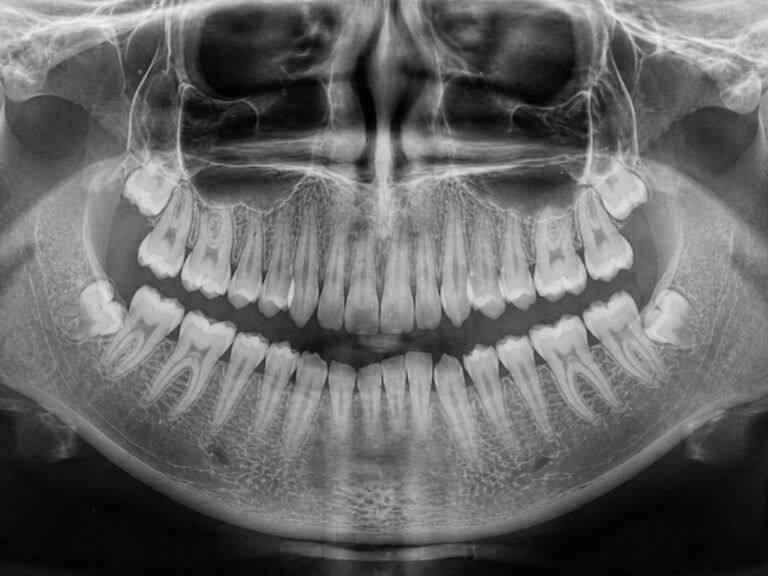
Feed a bitewing X-ray into the right algorithm and it will flag decay with the quiet confidence of a specialist who never blinks. Dozens of studies now report numbers that would make any radiologist nod along. So a team of restorative-dentistry researchers did the thing the marketing decks skip: they stacked up every one of those reviews, side by side, and asked a blunt question about AI caries detection — is the evidence underneath as solid as the scores printed on top?
The 30-Second Version
- A 2026 umbrella review in the Journal of Dentistry pooled 17 systematic reviews of AI for caries detection — a review of reviews, the top of the evidence pyramid.
- Where studies ran accuracy meta-analyses, AI looked strong: pooled sensitivity 0.76–0.94 and specificity 0.85–0.91, mostly on bitewing X-rays and intraoral photos.
- But the reviews overlapped heavily, leaned on retrospective data, and were rarely validated on outside patients — so the high scores rest on a narrow, repetitive base.
- The honest verdict: good enough to assist a dentist, not good enough to diagnose on its own — not yet.
It sounds settled. But in an umbrella review published in 2026 in the Journal of Dentistry, Ahmad Bittar, Rafael Dascanio and Mutlu Özcan did the unglamorous work of appraising the appraisals. Following PRIOR guidance and a pre-registered PROSPERO protocol, they searched five databases through March 2026, graded each review’s methodology with the AMSTAR 2 tool, and measured how much the reviews recycled the same underlying studies. Seventeen systematic reviews made the cut; five had pooled their numbers into formal diagnostic-accuracy meta-analyses. The guiding question: does dazzling performance in studies mean AI is ready to call a cavity on its own?
The study, in one glance
This wasn’t a new scanner or a new model — it was a critical appraisal sitting one level above the usual systematic review. Umbrella reviews synthesize other reviews rather than individual experiments, which makes them the closest thing evidence-based dentistry has to a bird’s-eye view of a whole field. The authors catalogued what the underlying systems did — mostly deep-learning models reading bitewing radiographs and intraoral photographs — how well they performed, and, crucially, how trustworthy the reviews reporting those results actually were, using AMSTAR 2 for methodological quality and the corrected covered area (CCA) to quantify how often the same primary studies kept reappearing.
What AI caries detection gets right
Taken at face value, the numbers are impressive. Across the five reviews that ran diagnostic-accuracy meta-analyses, pooled sensitivity landed between 0.76 and 0.94 and specificity between 0.85 and 0.91 — meaning the better systems caught the large majority of real lesions while keeping false alarms modest. Most ran on bitewing radiographs, the workhorse image for spotting decay between teeth, with a growing share trained on ordinary intraoral photographs. That is the same upside we saw when researchers tried to turn a smartphone photo into a cavity screener: an extra, tireless set of eyes that could help a busy clinician catch what a quick glance misses, and extend a first-pass check into places a specialist rarely reaches.
So why can’t AI diagnose a cavity on its own?
Because, the review argues, the shine is mostly in the lab — a pattern that recurs across AI diagnostics and imaging in dentistry. The same 17 reviews that produced those headline numbers share deep structural weaknesses. Most of the underlying studies were retrospective, built from pre-collected image sets rather than tested prospectively in a live clinic. External validation — where a model proves itself on patients and scanners it never trained on — was scarce. And reporting was inconsistent enough that the reviews often couldn’t be compared cleanly.
⚠ The same studies, counted many times
The authors measured a high corrected covered area, meaning the 17 reviews kept drawing on the same small pool of primary studies. When a dozen reviews reach the same upbeat conclusion from largely the same data, that is not a dozen independent confirmations. It is one body of evidence, echoed.
It’s less a chorus of independent witnesses than one voice in a hall of mirrors — the reflection looks like a crowd until you count the people.
Heterogeneity made things murkier still. Studies disagreed on the imaging modality, the threshold for what counts as a lesion, the diagnostic task, and even which metrics to report — so the tidy pooled ranges paper over a messy, inconsistent literature. High accuracy under curated experimental conditions, the authors caution, is not the same thing as reliability in the unpredictable conditions of a real mouth.
Who’s accountable when the model calls it wrong?
This is why the review stops short of endorsing stand-alone use. A sensitivity of 0.9 in a retrospective dataset says little about what happens when a model meets an unfamiliar camera, an atypical patient, or a lesion it was never shown. Until systems are validated prospectively and externally, the authors argue, AI belongs in a decision-support role — a second reader whose flags a dentist weighs — not an autonomous diagnostician whose verdict goes unchecked. The clinician, not the algorithm, stays answerable for the drill.
Better evidence for whom?
There’s an access dimension buried in the methodology. If the evidence base is narrow, repetitive and rarely tested outside the clinics that built it, we simply don’t know how these tools behave on the populations least represented in the training data — different equipment, different patients, under-resourced settings where a reliable screening aid would matter most. A tool can be “accurate” in the aggregate and still fail the specific communities a screening program is meant to reach. The umbrella review’s thin, overlapping foundation is exactly why those questions stay open.
What this means for you
If you’re a patient
If your dentist uses AI to read your X-rays, treat it as a helpful second opinion, not a verdict. A flagged spot still deserves a clinician’s judgment about whether to watch, seal or treat it — and a clean AI scan is reassurance, not a cast-iron guarantee.
If you’re a clinician
The pooled numbers are encouraging, but ask the question the review insists on: was this system validated prospectively, on patients and equipment like yours? Until that box is ticked, use AI as a second reader that sharpens your eye, and keep the diagnostic call your own.
The bottom line
AI can already read a bitewing with striking accuracy — but an umbrella review is a reminder that a pile of confident studies is not the same as settled science. The scores are real; the foundation beneath them is thinner and more repetitive than the headlines suggest. For now, AI caries detection is a sharp assistant worth auditing, not an oracle worth trusting — and the fix isn’t a cleverer algorithm so much as better, braver evidence: prospective, external, and honestly reported.
Frequently asked questions
Does AI accurately detect cavities?
In studies, yes — this 2026 umbrella review found pooled sensitivity of 0.76–0.94 and specificity of 0.85–0.91 across five meta-analyses, mostly on bitewing X-rays. But the reviewers warn those numbers come from mostly retrospective, rarely externally validated research, so real-world accuracy may be lower.
What is an umbrella review, and why does it matter here?
An umbrella review synthesizes existing systematic reviews rather than individual studies — a review of reviews. It sits at the top of the evidence hierarchy and is built to show whether a field’s many reviews agree for good reasons, or simply recycle the same limited data.
Can AI replace a dentist for diagnosing caries?
Not on this evidence. The review concludes AI should stay in a decision-support role until prospective, external validation proves it works beyond the datasets it was trained on. The clinician still makes the final call.
Why didn’t 17 reviews settle the question?
Because they overlapped heavily — a high “corrected covered area” meant they kept citing the same primary studies — and they varied widely in imaging type, lesion thresholds and metrics. Many confident conclusions drawn from the same narrow data don’t add up to independent proof.
What would make AI caries detection trustworthy?
Prospective testing in real clinics, external validation on new patients and devices, consistent reporting standards, and evidence that it improves patient outcomes — not just that it scores well on stored images.
Source & author credit
This article interprets, and does not reproduce, the following peer-reviewed study. All figures are the authors’ original findings.
Bittar A, Dascanio R, Özcan M. Artificial intelligence for dental caries detection: An umbrella review. Journal of Dentistry. 2026;175:106944. DOI: 10.1016/j.jdent.2026.106944
ORCID — Ahmad Bittar: 0009-0009-3305-5298 · Rafael Dascanio: 0000-0002-9459-1926 (no ORCID iD was registered for M. Özcan in the article’s Crossref metadata at the time of writing).
Source article © 2026 Elsevier Ltd, published in the Journal of Dentistry (subscription access); figures and statistics here are interpreted from the published abstract and record, with no copyrighted text or figures reproduced. Decadentry is an independent educational publication and is not affiliated with the study’s authors.
Leave a Reply