

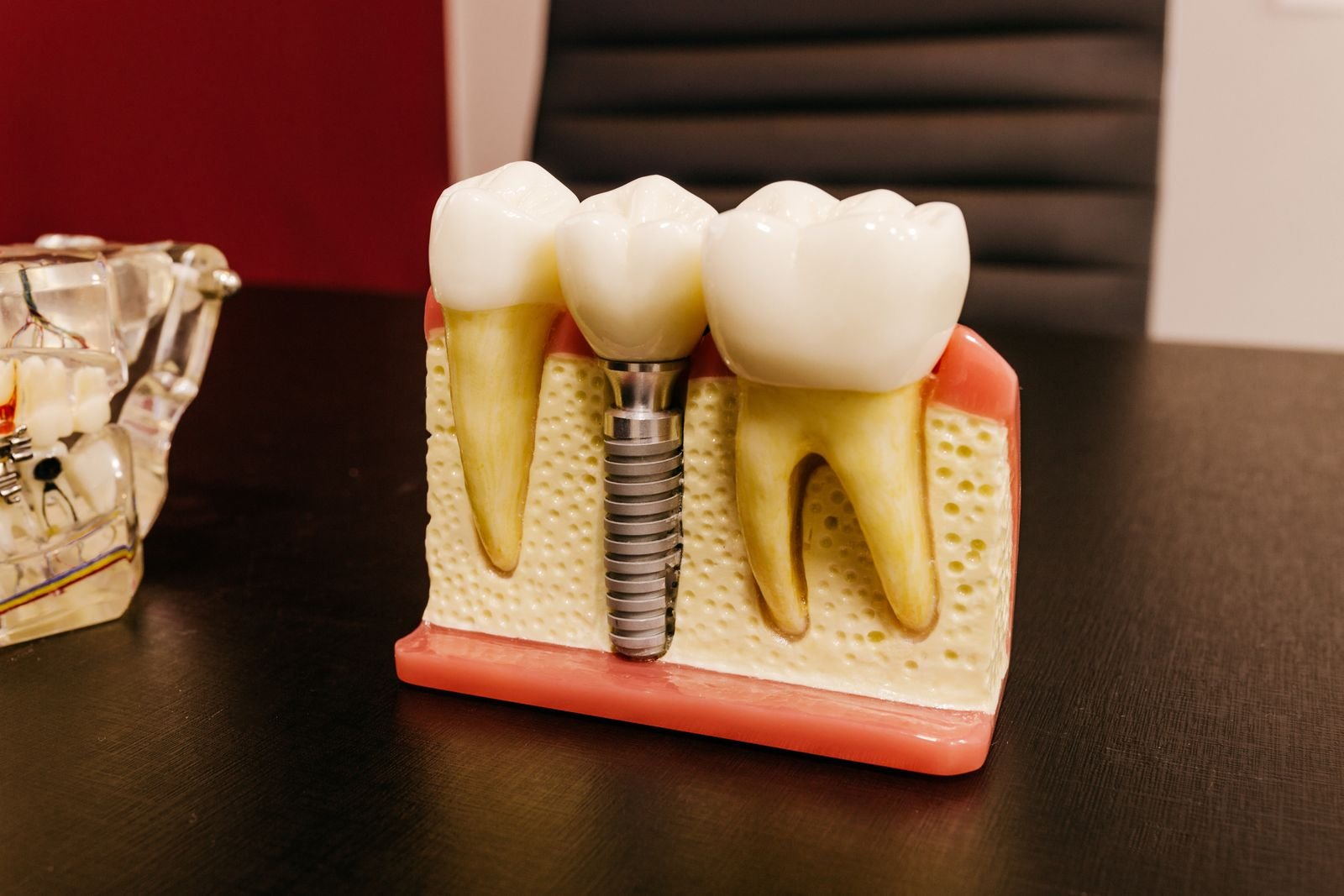
The implant looked perfect. Osseointegrated, loaded, crown seated, patient happy. And yet, buried in the grey pixels of that first routine X-ray — taken before anything had gone wrong — may lie a quiet signature of trouble still years away. A new study puts AI-driven peri-implantitis prediction to the test.
The 30-Second Version
- Researchers at the University of Michigan and King’s College London trained AI to forecast peri-implantitis — gum-and-bone disease around a dental implant — from a single baseline X-ray taken within a year of fitting the crown.
- The best model reached an AUC of 0.83, clearly beating a coin flip, hinting that early warning signs are visible before any clinical sign appears.
- But it caught only two of every three future cases (66.7% sensitivity), and the whole result rests on a small, two-clinic, look-back dataset with no outside validation.
- The honest verdict: a promising risk flag for implant maintenance, not a crystal ball — and nowhere near ready for the clinic.
It sounds revolutionary: hand a computer the X-ray you already take at every implant check-up, and have it whisper which implants will quietly fail. So let’s name the study. Writing in Clinical Oral Investigations (2026), Muhammad Saleh, Luigi Nibali, Giuseppe Troiano and colleagues ran a multi-center, longitudinal, retrospective test of peri-implantitis prediction using transfer learning — the trick of borrowing a neural network already trained on millions of everyday photos and re-pointing it at dental radiographs. The guiding question is deceptively simple: can a baseline image, taken while everything still looks fine, predict disease that only shows up years later?
The study, in one glance
The team gathered 195 implants in 108 maintained patients — 146 implants from Michigan, 49 from London — all placed between 2009 and 2023 and followed for an average of about seven and a half years. For each implant they pulled one baseline periapical X-ray taken within a year of the crown going in, cropped to a strip 2 mm either side of the implant. Over the follow-up, 28 of those implants went on to develop peri-implantitis; the rest stayed healthy. Five pre-trained networks (ResNet50, DenseNet, VGG16, InceptionV3, EfficientNet) were each tried with four ways of adapting them, and — crucially — the data were split by patient, so no patient’s implants appeared in both training and testing.
The genuinely impressive part: disease that hasn’t happened yet
Most AI in implant dentistry so far has done detection — spotting bone loss that is already there, which is a bit like a smoke detector that only sounds once the room is full of smoke. This study is trying something harder and more interesting: prediction. The X-rays it learned from were taken while the implants looked healthy, and the disease it was asked to foresee arrived, on average, years later. That the best setup reached an AUC of 0.83 — well above the 0.50 you’d get by guessing — suggests that something real and subvisual is written into that first image: subtle textures of bone quality and architecture that a human eye slides right past. The authors frame it exactly right, as a way to flag higher-risk implants and tailor recall intervals, oral-hygiene reinforcement and early preventive care — a co-pilot for maintenance, not a replacement for the clinician.
So why does the best model still miss one implant in three?
Because 0.83 is a headline, and sensitivity is the fine print. At the standard decision threshold, the top model (InceptionV3) correctly flagged only 66.7% of implants that truly went on to fail, while correctly clearing 76.9% of the healthy ones. In plain terms: a third of future peri-implantitis cases slipped through as “all clear.” And the five models were far from unanimous — their AUCs in the best configuration ranged from a near-useless 0.59 (VGG16) up to 0.83, and when the team tried to fine-tune the networks more aggressively, performance collapsed as low as 0.42, with one model flagging zero true cases. A tool whose usefulness depends this heavily on which version you happen to run is a tool still in the workshop.
⚠ A handful of cases carrying a big number
The independent test set was just 10% of the data — fewer than twenty implants, only a small handful of which ever developed disease. When the denominator is that tiny, a single missed case can swing sensitivity by double digits. The 0.83 is encouraging, but it is a fragile 0.83.
It’s a weather forecast for a tooth: better than a coin flip at calling rain, but it would still send you out without an umbrella one day in three.
There’s a second, quieter limit. The model saw only the X-ray — a flat, 2D, interproximal strip of bone. It never saw the gums: no bleeding, no probing depths, no soft-tissue thickness, no checks for inflammation, none of the clinical signals that actually define peri-implantitis. It is reading one chapter of a longer story and guessing the ending.
Can peri-implantitis prediction travel from two clinics to a third?
This is the question that decides whether any medical AI is real or just a lab curiosity, and here the honest answer is: we don’t know yet. The data came from two university cohorts, pooled and then split — never tested on a genuinely external clinic, scanner or population. Real-world peri-implantitis runs around 20% of implants, and a model’s numbers can look very different once the mix of implant systems, prosthetic designs and patient risk shifts. The study is retrospective and, by the authors’ own admission, limited in size; they are explicit that larger, prospective validation must come before anyone trusts this at the chairside. That candor is a feature, not a flaw — it’s how good science hands you a promising lead without overselling it.
Who gets the benefit — and who gets the false reassurance?
If a prediction tool like this matured, the upside would flow to people with the most to lose from a silent failure: patients with a history of gum disease (72% of this cohort had one), smokers, those with systemic risk. The danger is the mirror image. A model that misses a third of future cases could hand exactly those patients a falsely clean bill — “the AI says your implant is low-risk” — and nudge everyone toward fewer check-ups just as the quiet bone loss begins. An early-warning system that fails silently is worse than none, because it spends the one thing a maintenance program runs on: the patient’s attention.
What this means for you
If you’re a patient
Nothing here changes your next visit. There is no approved app that reads your implant X-ray and predicts its future, and even this research tool misses a third of cases. The proven protection for an implant is unchanged and unglamorous: regular maintenance visits, good home cleaning, and controlling risks like smoking and gum disease.
If you’re a clinician
Watch this space, don’t act on it. The idea that a baseline radiograph carries predictive signal is genuinely exciting and worth following, but a two-center retrospective model with 66.7% sensitivity and no external validation isn’t a recall-planning tool yet. Keep leaning on established risk assessment; let the prospective trials run.
The bottom line
This study found a faint but real fingerprint of future disease hiding in an ordinary implant X-ray — and that’s a finding worth celebrating. But 0.83 is a direction, not a destination. Until it has been tested prospectively, in clinics it has never seen, the right way to hold a result like this is as a research signal pointing toward smarter maintenance, not a verdict delivered to a patient. An assistant, not an oracle.
Frequently asked questions
What is peri-implantitis, and why predict it?
Peri-implantitis is inflammation around a dental implant that progressively destroys the bone holding it in place. It affects roughly one in five implants over time and often advances silently. Predicting it from a baseline X-ray — before clinical signs appear — could let clinicians schedule closer check-ups and start preventive care earlier for the implants most at risk.
How accurate was the AI at predicting peri-implantitis?
The best model (InceptionV3) reached an AUC of 0.83, comfortably better than the 0.50 of random guessing. But at the usual decision threshold it correctly identified only 66.7% of implants that later developed disease and correctly cleared 76.9% of healthy ones — so it still missed about a third of future cases.
Can my dentist use this to check my implant today?
No. This is early-stage research, not an available product. It was built and tested only on data from two universities, was never validated on an outside clinic, and misses too many cases to guide real decisions. Routine maintenance visits and good home care remain the proven way to protect an implant.
Why does a small test set matter so much?
The model was judged on fewer than twenty implants, only a small handful of which developed disease. With numbers that small, one case going the wrong way can move the headline accuracy by double digits, so the promising scores are statistically fragile and need confirming in much larger, prospective studies.
Source & author credit
This article interprets, and does not reproduce, the following peer-reviewed study. All figures are the authors’ original findings.
Saleh MHA, Nibali L, Alrmali AE, Caponio VCA, Santamaria P, Fanelli F, Zhurakivska K, Wang HL, Troiano G. Accuracy of transfer learning in predicting peri-implantitis onset from intraoral radiograph: A multi-center longitudinal retrospective study. Clinical Oral Investigations. 2026;30(11):537. DOI: 10.1007/s00784-026-07181-3
ORCID — Francesco Fanelli: 0009-0009-3756-3580
Published open access under a Creative Commons Attribution 4.0 (CC BY 4.0) licence. Decadentry is an independent educational publication and is not affiliated with the study’s authors. Our editorial standards and methodology explain how each study is chosen and fact-checked, and this piece sits in our Implants & Oral Surgery research hub alongside related work such as AI gum-disease prediction.
Leave a Reply