


Ninety-nine percent. In a diagnostic study, that number does something to a room — it ends the argument before it starts. If a machine can read a dental X-ray as accurately as the best specialist alive, why would anyone push back? But a sweeping new review of AI dental diagnosis asks a sharper question: ninety-nine percent of what, measured how, and would the number survive its first visit to a clinic that didn’t build it?
The 30-Second Version
- A 2026 Journal of Dentistry systematic review pooled 96 studies of AI for dental diagnosis across every major specialty.
- Reported accuracy was dazzling — 81% to 99%, with implants, orthodontics and endodontics at the top of the range.
- But 55.2% of studies carried a high risk of bias, 90.6% were retrospective, and most were never tested outside the data they were built on.
- The honest verdict: today’s evidence shows these tools are promising — not that they’re ready to diagnose on their own.
It sounds like the future already arrived. But before you trust the scoreboard, read the fine print. In the Journal of Dentistry (2026), Adel Alrayes, Dimitrios Kollias and Aylin Baysan of Queen Mary University of London did something most AI papers skip: they audited the audits. Following PRISMA and a registered protocol (PROSPERO CRD42025639340), they assembled 96 studies of AI for dental diagnosis and graded each one not on how clever it was, but on whether its accuracy could be believed — using QUADAS-2, Cochrane RoB 2, TRIPOD-AI and PROBAST+AI, the standard yardsticks for clinical-evidence quality. Their guiding question wasn’t “how smart is the AI?” It was “how trustworthy is the proof?”
The study, in one glance
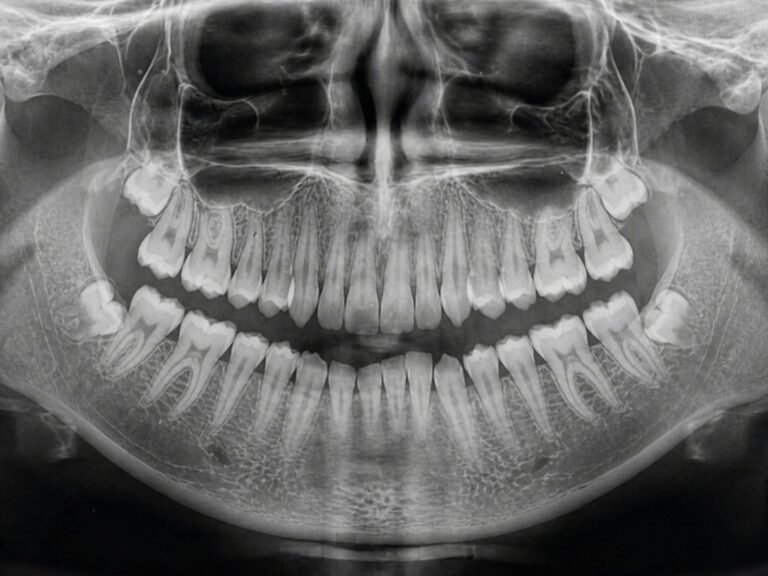
The reviewers searched seven databases plus a trials registry — PubMed/MEDLINE, Scopus, Embase, LILACS, Cochrane CENTRAL, Web of Science and ClinicalTrials.gov — through December 2025, with two reviewers independently selecting studies and extracting data. Ninety-six studies made the cut, spanning diagnostics across implantology, orthodontics, endodontics and more. Convolutional neural networks dominated (82.3% of the models), and panoramic radiographs and cone-beam CT were the workhorse images. Then came the part that matters most: a cold, structured look at how each piece of evidence was actually built.
Where AI dental diagnosis genuinely impresses
Strip away the caveats for a moment, because the capability is real. Across the 96 studies, reported diagnostic accuracy ran from 81% all the way to 99%. The strongest showings came in implantology (92–99%), orthodontics (88–99%) and endodontics (87–99%) — pattern-heavy tasks like flagging a feature on an implant, placing a cephalometric landmark, or catching the shadow of a lesion at a root tip, where a tireless matcher can keep pace with a sharp human eye. A convolutional network reads a panoramic film in seconds and never gets bored on the two-hundredth radiograph of the day. As a second set of eyes, that isn’t hype — it’s genuinely useful.
Ninety-nine percent — but on whose data?
Here’s the catch the headline accuracy hides. More than half the studies — 55.2% by QUADAS-2 — carried a high risk of bias, and 90.6% were retrospective, meaning the AI was tested on data much like the data it learned from. Most importantly, the review found that the great majority of models were never externally validated: never tried on a different clinic’s patients, a different scanner, or a different population. A score earned only on home turf shows a model can memorize. It doesn’t show the model can generalize.
⚠ A 99% that never left home
Reported accuracy and real-world reliability are not the same measurement. An internally-tested, retrospective model can post a near-perfect score and still stumble the first time it meets an unfamiliar X-ray — which is precisely the situation at every clinic that didn’t supply the training data.
It’s the student who aces the practice exam — because she wrote the questions and graded her own answers.
The reporting was thin where it counts, too. Judged against TRIPOD-AI, studies routinely skipped the housekeeping that lets others check the work: justifying the sample size, explaining how missing data were handled, publishing a protocol, registering the study, and sharing data or code. Sixteen studies didn’t even state which CNN architecture they used. You can’t reproduce what was never fully described — and this is a pattern the field has flagged before, from explainable AI in dentistry to AI caries-detection reviews.
If you can’t check the proof, can you trust the tool?
This is where accuracy and accountability part ways. A model that can’t be reproduced can’t really be scrutinized, and a tool that can’t be scrutinized is asking for faith, not trust. The reviewers’ prescription is blunt: more prospective designs, external validation on independent cohorts, and transparent reporting. Until those catch up, a dazzling accuracy figure is a promissory note, not a guarantee — and the clinician, not the algorithm, still owns the diagnosis.
Who gets left out of a 99%?
The external-validation gap isn’t just a statistical nicety — it’s an equity question. If a caries or implant model was trained and tested at a handful of academic centers, we simply don’t know how it behaves on the populations, bone densities, and older or lower-cost scanners it never saw. Most of this work in AI diagnostics and imaging leans on panoramic and cone-beam CT images from well-resourced clinics. A tool that works brilliantly for the patients who resemble its training set — and quietly worse for everyone else — can widen gaps in care while looking, on paper, 99% right.
What this means for you
If you’re a patient
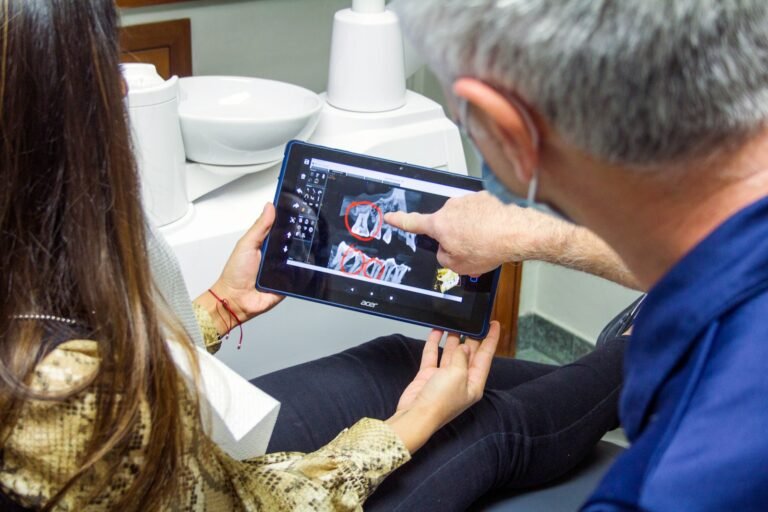
If your dentist uses AI to help read your scans, that’s a good thing — a well-built model is a sharp second opinion. But it’s your dentist, not the software, who makes the diagnosis and answers for it. It’s fair to ask whether a tool has been tested beyond the lab that built it.
If you’re a clinician
Treat vendor accuracy claims as a starting line, not a finish line. Ask what this review asks: Prospective or retrospective? Externally validated — on whose data? Reproducible? A CNN is a superb assistant for triage and a dangerous master for autonomous diagnosis while the evidence base is this uneven.
The bottom line
AI can already read a dental image with startling skill. What this review shows is that we have measured the skill far more carefully than we have measured the trust. Until external validation and transparent reporting catch up to the accuracy, these systems are best understood as instruments a clinician wields — assistants, not oracles. The number on the scoreboard is real. So is the fine print.
Frequently asked questions
Is AI accurate enough to diagnose dental problems on its own?
Not yet, according to this review. Reported accuracy is high (81–99%), but because most studies were retrospective and more than half carried a high risk of bias, the evidence supports AI as a decision-support tool alongside a clinician — not as a standalone diagnostician.
What does “high risk of bias” actually mean here?
It means the way a study was designed or reported could inflate or distort its results — for example, testing only on cherry-picked images, or on the same kind of data the model learned from. The reviewers used QUADAS-2 and PROBAST+AI, standard tools for judging clinical-evidence quality, and flagged 55.2% of studies as high risk.
Why is “external validation” such a big deal?
External validation means testing a model on data it has never seen — a different clinic, scanner, or population. Without it, a near-perfect score may only prove the model memorized its training environment. The review found external validation was rare, which is why even a 99% figure comes with an asterisk.
Which dental tasks did AI perform best on?
The highest reported accuracy ranges were in implantology (92–99%), orthodontics (88–99%) and endodontics (87–99%). But these figures come largely from retrospective, internally-validated studies, so they reflect potential more than proven real-world performance.
Source & author credit
This article interprets, and does not reproduce, the following peer-reviewed study. All figures are the authors’ original findings.
Alrayes A, Kollias D, Baysan A. A Systematic Review of Bias, Validation, and Explainability in Artificial Intelligence Algorithms for Dental Diagnostics. Journal of Dentistry. 2026; article 107151. DOI: 10.1016/j.jdent.2026.107151
ORCID — Aylin Baysan (corresponding author): 0000-0001-8775-3950. Public ORCID iDs were not listed for the remaining authors.
Published open access under a Creative Commons Attribution (CC BY 4.0) licence. Decadentry is an independent educational publication and is not affiliated with the study’s authors. Our work is checked against its primary source — see our editorial standards.
Leave a Reply